Butter Conversion Master Table: Sticks to Grams to Cups to Ounces
"Use this butter conversion chart to convert sticks, cups, tablespoons, ounces, and grams for salted, unsalted, cold, softened, and melted butter."
Converting butter in baking requires navigating three distinct measurement systems: US sticks, volume cups, and weight in grams or ounces. If you are baking an American recipe that calls for 1 stick of butter, an international recipe listing 100 grams, or a vintage cookbook specifying ounces, knowing the exact mathematical conversion is essential for perfect pastry structure and dough hydration.
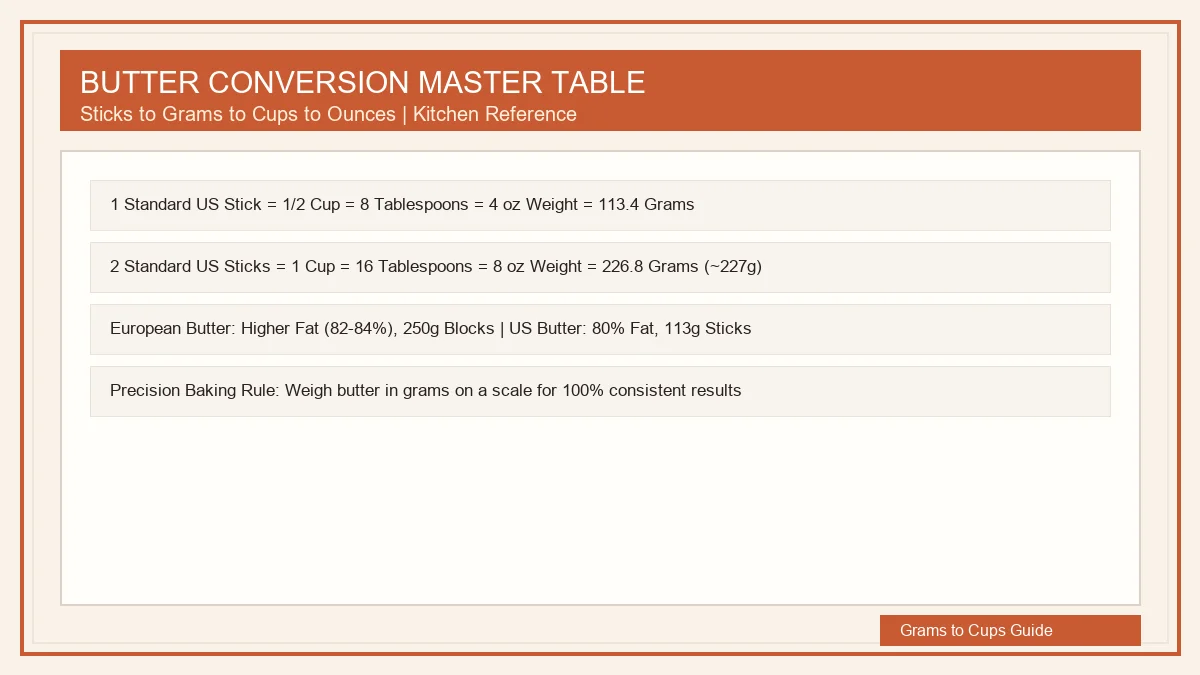
The standard US butter stick conversion baseline is: 1 US stick of butter = 1/2 US customary cup = 8 tablespoons = 4 ounces by weight = 113.4 grams (commonly rounded to 113g or 113.5g in recipe development). Consequently, 1 full cup of butter (2 sticks) = 16 tablespoons = 8 ounces by weight = 226.8 grams (standardized by King Arthur Baking and USDA reference tables as 227 grams). Clearly identifying this US butter-stick convention prevents confusion when baking with international butter blocks or European recipes.
Convert stick fractions with our interactive Butter Stick Converter, explore the complete Dairy & Fat Conversions Hub, and convert small amounts via the Tablespoons to Grams Calculator.
Butter Conversion Quick Reference
Use this master reference chart to convert sticks, cups, tablespoons, weight ounces, and grams across all standard butter quantities used in domestic and professional baking:
| Amount Description | US Customary Cups | Tablespoons (tbsp) | US Butter Sticks | Ounces by Weight (oz) | Weight in Grams (g) |
|---|---|---|---|---|---|
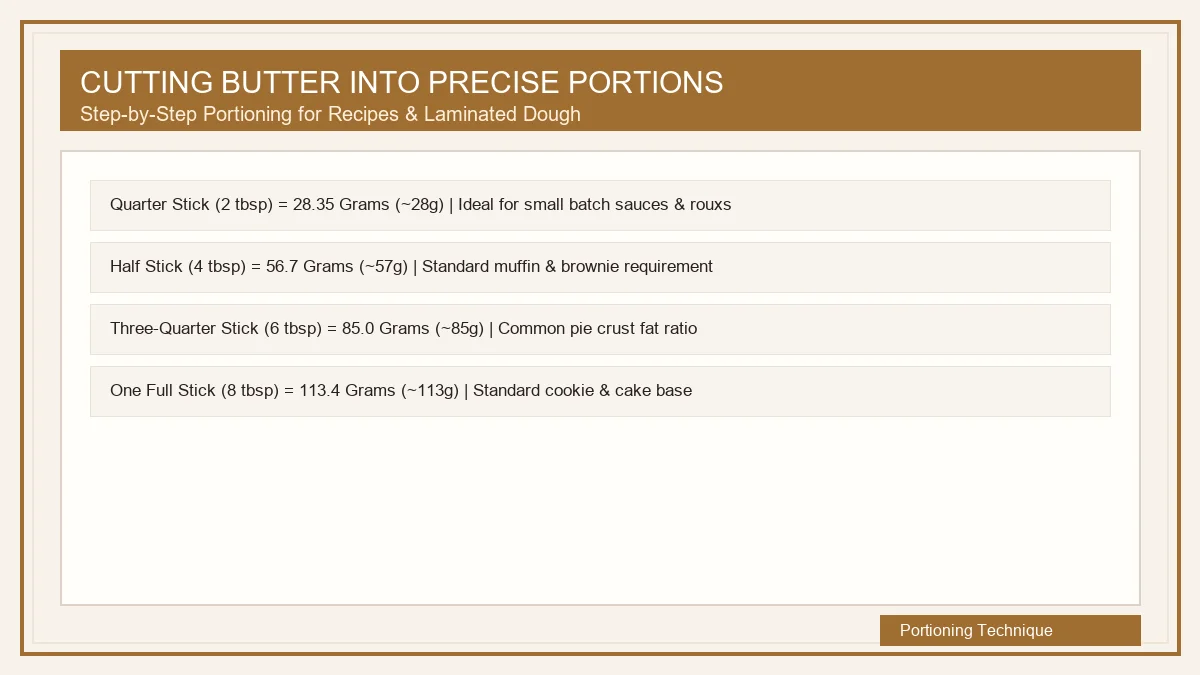
| 1/4 Stick (Quarter Stick) | 1/8 Cup (0.125 cup) | 2 tbsp | 0.25 Stick | 1.0 oz | 28.35 g (~28g) |
| 1/2 Stick (Half Stick) | 1/4 Cup (0.25 cup) | 4 tbsp | 0.5 Stick | 2.0 oz | 56.70 g (~57g) |
| 1 Stick (Standard US Stick) | 1/2 Cup (0.5 cup) | 8 tbsp | 1.0 Stick | 4.0 oz | 113.4 g (~113g) |
| 1.5 Sticks (One & Half) | 3/4 Cup (0.75 cup) | 12 tbsp | 1.5 Sticks | 6.0 oz | 170.1 g (~170g) |
| 2 Sticks (1 Full Cup / Half Pound) | 1.0 Cup | 16 tbsp | 2.0 Sticks | 8.0 oz (0.5 lb) | 226.8 g (~227g) |
| 3 Sticks (1.5 Cups / Three-Quarter Pound) | 1.5 Cups | 24 tbsp | 3.0 Sticks | 12.0 oz (0.75 lb) | 340.2 g (~340g) |
| 4 Sticks (2 Full Cups / One Pound Block) | 2.0 Cups | 32 tbsp | 4.0 Sticks | 16.0 oz (1.0 lb) | 453.6 g (~454g) |
Butter Sticks to Grams
To convert American butter sticks to grams, use the exact conversion multiplier based on standard US packaging: 1 stick of butter = 113.4 grams. Multiply the number of sticks by 113.4 (or 113 for practical kitchen rounding):
Formula: Grams = US Sticks * 113.4
1/4 Stick Butter: 0.25 * 113.4 = 28.35 grams (~28g)
1/2 Stick Butter: 0.50 * 113.4 = 56.70 grams (~57g)
1 Stick Butter: 1.00 * 113.4 = 113.40 grams (~113g)
1.5 Sticks Butter: 1.50 * 113.4 = 170.10 grams (~170g)
2 Sticks Butter: 2.00 * 113.4 = 226.80 grams (~227g)
2.5 Sticks Butter: 2.50 * 113.4 = 283.50 grams (~284g)
3 Sticks Butter: 3.00 * 113.4 = 340.20 grams (~340g)
4 Sticks Butter: 4.00 * 113.4 = 453.60 grams (~454g)
Grams to Butter Sticks
When executing European or metric recipes that list butter in grams, converting back to US sticks requires dividing the target gram weight by 113.4. Here are mathematically precise conversions alongside practical recipe rounding:
Formula: US Sticks = Grams / 113.4
57g Butter: 56.7g / 113.4 = 0.50 Sticks (Exactly 1/2 Stick / 4 tbsp / 1/4 Cup)
113g Butter: 113.4g / 113.4 = 1.00 Stick (Exactly 1 Stick / 8 tbsp / 1/2 Cup)
170g Butter: 170.1g / 113.4 = 1.50 Sticks (Exactly 1.5 Sticks / 12 tbsp / 3/4 Cup)
227g Butter: 226.8g / 113.4 = 2.00 Sticks (Exactly 2 Sticks / 16 tbsp / 1 Full Cup)
340g Butter: 340.2g / 113.4 = 3.00 Sticks (Exactly 3 Sticks / 24 tbsp / 1.5 Cups)
454g Butter: 453.6g / 113.4 = 4.00 Sticks (Exactly 4 Sticks / 32 tbsp / 2 Full Cups / 1 lb Block)
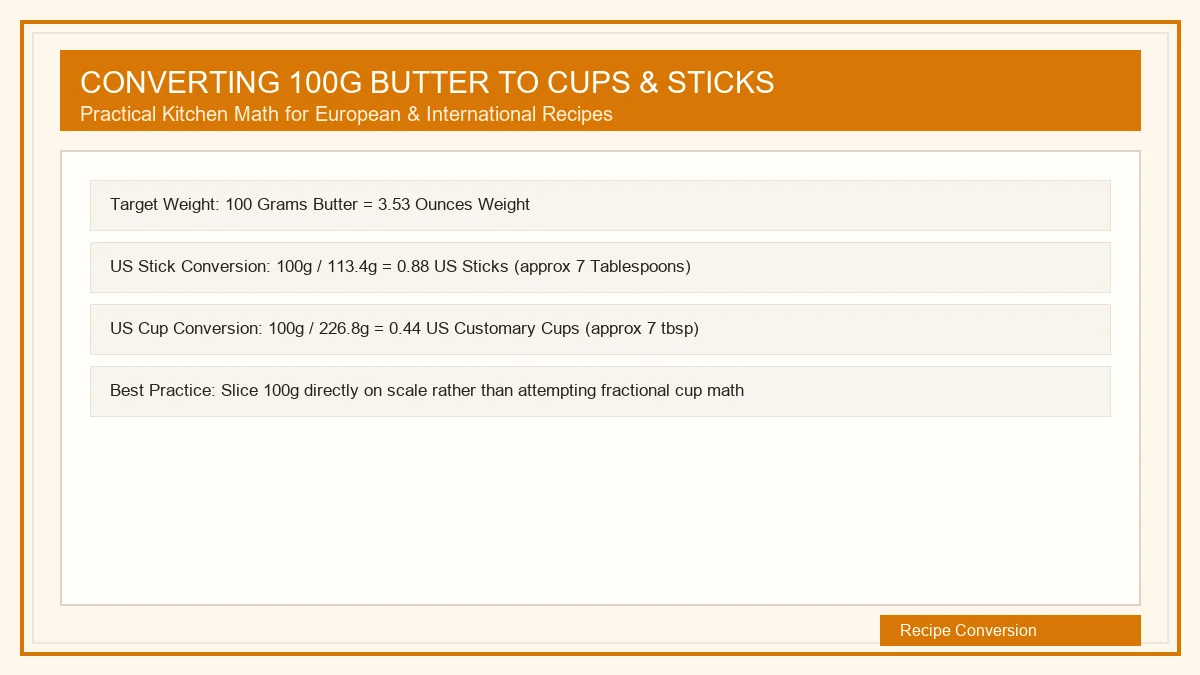
For non-standard gram amounts like 100g, 200g, or 250g, calculating fractional sticks yields 0.88 sticks for 100g, 1.76 sticks for 200g, and 2.21 sticks for 250g. Weighing directly on a scale eliminates awkward stick slicing.
Butter Cups to Grams
In standard US customary measurements, 1 cup of butter equals 226.8 grams, which is rounded to 227 grams by major baking test kitchens including King Arthur Baking. Conversely, half a cup of butter (1 stick) equals 113.4g (rounded to 113g).
Refer to the breakdown below when converting fractional cups of butter into grams:
| Fractional Cup Volume | Tablespoon Equivalent | Exact Mass (Grams) | Standard Recipe Rounding | US Stick Portion |
|---|---|---|---|---|
| 1/4 Cup Butter | 4 tbsp | 56.70 g | 57 g | 1/2 Stick |
| 1/3 Cup Butter | 5.33 tbsp (5 tbsp + 1 tsp) | 75.60 g | 76 g | 0.67 Stick |
| 1/2 Cup Butter | 8 tbsp | 113.40 g | 113 g (113.5g) | 1 Stick |
| 2/3 Cup Butter | 10.67 tbsp (10 tbsp + 2 tsp) | 151.20 g | 151 g | 1.33 Sticks |
| 3/4 Cup Butter | 12 tbsp | 170.10 g | 170 g | 1.5 Sticks |
| 1 Full Cup Butter | 16 tbsp | 226.80 g | 227 g | 2 Sticks |
To convert other core baking ingredients from volume to weight, consult The Master Cups to Grams Baking Conversion Guide.
Butter Tablespoons to Grams
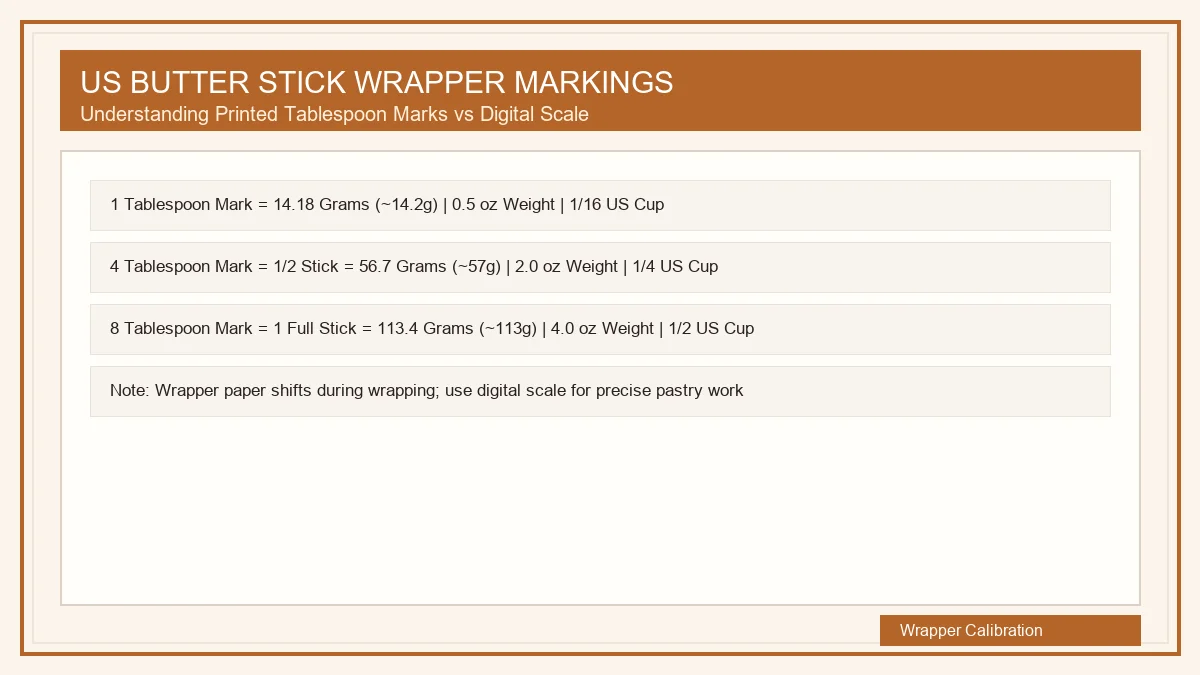
Because 1 standard US stick of butter contains 8 tablespoons and weighs 113.4 grams, 1 tablespoon of butter weighs approximately 14.18 grams (commonly rounded in domestic kitchen calculations to 14 grams or 14.2 grams).
When converting individual tablespoon measurements to grams:
- 1 Teaspoon Butter (1/3 tbsp): 4.73 grams (~4.7g)
- 1 Tablespoon Butter: 14.18 grams (~14.2g)
- 2 Tablespoons Butter (1/8 cup): 28.35 grams (~28g / 1 oz)
- 3 Tablespoons Butter: 42.53 grams (~42.5g)
- 4 Tablespoons Butter (1/4 cup / 1/2 stick): 56.70 grams (~57g / 2 oz)
- 6 Tablespoons Butter (3/8 cup / 3/4 stick): 85.05 grams (~85g / 3 oz)
- 8 Tablespoons Butter (1/2 cup / 1 stick): 113.40 grams (~113g / 4 oz)
It is important to understand that tablespoon conversions are approximate practical values. Do not imply that every domestic tablespoon scoop or knife slice is laboratory exact. Wrapper paper markings can shift during factory printing and wrapping, so weighing on a scale is best for exact pastry work.
Butter Ounces to Grams
A frequent point of confusion in culinary baking is the distinction between weight ounces (mass) and fluid ounces (liquid volume). Butter is normally measured by weight ounces when discussing ounces in baking recipes.
One avoirdupois ounce by weight equals exactly 28.3495 grams (commonly rounded to 28.35g or 28.3g). Here is how common butter weight ounce specifications convert into grams:
| Weight Ounces (oz) | Gram Equivalent (g) | US Stick Equivalent | US Cup Equivalent |
|---|---|---|---|
| 1 oz Weight | 28.35 g | 1/4 Stick (2 tbsp) | 1/8 Cup |
| 2 oz Weight | 56.70 g | 1/2 Stick (4 tbsp) | 1/4 Cup |
| 4 oz Weight (1 Stick) | 113.40 g | 1.0 Stick (8 tbsp) | 1/2 Cup |
| 6 oz Weight | 170.10 g | 1.5 Sticks (12 tbsp) | 3/4 Cup |
| 8 oz Weight (1/2 lb) | 226.80 g (~227g) | 2.0 Sticks (16 tbsp) | 1 Full Cup |
| 12 oz Weight (3/4 lb) | 340.20 g | 3.0 Sticks (24 tbsp) | 1.5 Cups |
| 16 oz Weight (1 lb Block) | 453.60 g (~454g) | 4.0 Sticks (32 tbsp) | 2 Full Cups |
Do not confuse 8 ounces by weight of butter (227g) with 8 fluid ounces of liquid water or milk (236.6 mL). Liquid volume fluid ounces measure space, whereas dry weight ounces measure solid mass.
How to Measure Butter From the Wrapper
In North America, commercial butter sticks are wrapped in waxed paper or foil printed with calibrated tablespoon measurement markings. Each hash line demarcates 1 tablespoon (14.2g / 0.5 oz) of butter, dividing the stick into 8 equal segments.
To measure butter using wrapper markings:
- Keep butter chilled: Cold butter retains its rectangular shape, allowing clean slicing along printed lines.
- Unwrap partially: Peel back the paper wrapper without removing it completely to keep your hands clean.
- Slice with a sharp knife: Cut straight down through the butter stick at the desired tablespoon line.
- Re-wrap remaining butter: Fold the paper wrapper back over the cut end to prevent refrigeration odor absorption.
Wrapper Convenience vs Weight Reliability
While printed wrapper markings are exceptionally convenient for quick weeknight cooking, wrapper alignment is not 100% laboratory precise. During high-speed commercial packaging, paper wrappers can shift up to 1/8 inch (3 mm), creating a 2-to-5-gram variance between sliced ends. For high-stakes baking like pie crusts, French macarons, and croissants, verifying weight on a digital scale is far more reliable.
Cold vs Softened vs Melted Butter
The physical temperature state of butter fundamentally alters how it occupies volume and how it must be measured. Understanding recipe wording prevents major hydration and texture mistakes:
Cold Butter (Chilled)
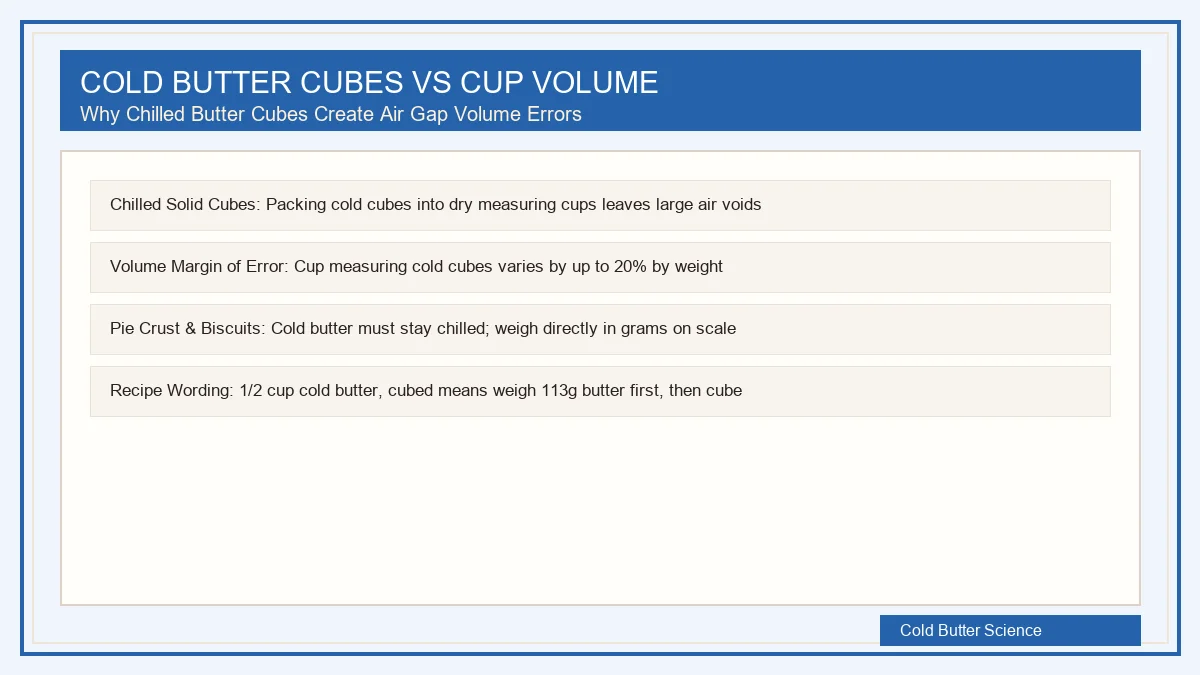
Firm, rigid blocks used in pie crusts, biscuits, and scones. Dicing cold butter into dry measuring cups leaves large air voids between cubes, introducing volume errors up to 20%. Always weigh cold butter in grams before cubing.
Softened Butter (Room Temp)
Pliable at ~65°F–68°F (18°C–20°C) for creaming with sugar in cakes and cookies. Packing softened butter into measuring cups leaves heavy grease residual on cup walls. Slicing along wrapper lines or weighing is preferred.
Melted Butter (Liquid)
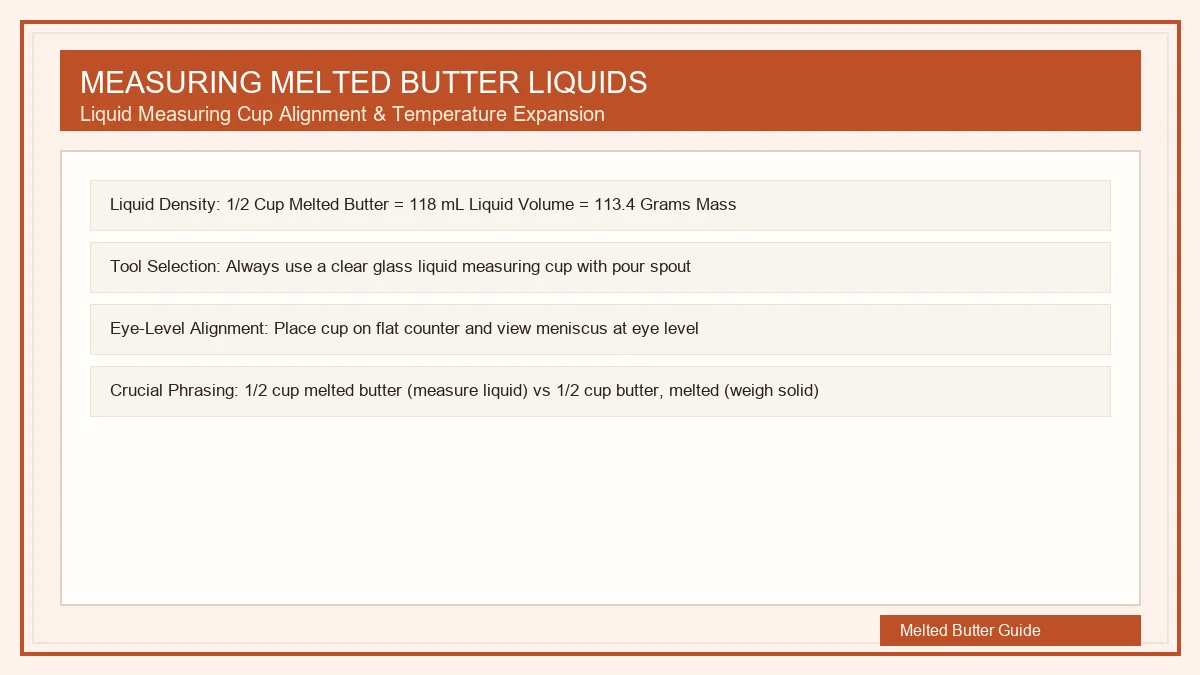
Liquid state used in brownies, pancakes, and quick breads. Liquefied butter expands slightly in volume (1/2 cup melted butter = ~118 mL). Always measure melted butter in a clear glass liquid cup or weigh on a scale.
Crucial Recipe Phrasing: Pre-Melting vs Post-Melting
Pay close attention to where the word "melted" appears in a recipe ingredient list:
- "1/2 cup butter, melted": Measure or weigh 1/2 cup (1 stick / 113g) of solid butter FIRST, and then melt it.
- "1/2 cup melted butter": Melt a quantity of butter FIRST, and then measure out exactly 1/2 cup (118 mL) of liquid melted butter.
Learn more about measuring tool selection in our analysis: Liquid Measuring Cups vs Dry Measuring Cups: Are They Interchangeable?.
Salted vs Unsalted Butter
Standard commercial butter is sold in salted and unsalted varieties. While salted and unsalted butter have virtually identical mass density (~113.4g per stick), their chemical formulation affects recipe outcomes:
- Salt Content Variance: Salted butter contains approximately 1.5% to 2% added salt by weight. One standard stick of salted butter (113g) contains roughly 1.5g to 2g of salt (approx 1/4 teaspoon to 3/8 teaspoon of fine table salt).
- Recipe Salt Control: Unsalted butter (often labeled "sweet cream butter") allows bakers to control exact salt quantities in delicate doughs, preventing over-salted crusts or yeast suppression.
- Water Content & Freshness: Salt acts as a natural preservative, extending shelf life. Unsalted butter is often fresher in grocery stores because it lacks salt preservatives.
- Brand Differences: Do not claim every butter brand contains the exact same salt quantity. Land O'Lakes, Kerrygold, and Cabot vary slightly in their salt percentage per stick.
American Butter vs European Butter
Baking European recipes with American butter, or vice versa, introduces structural differences due to fat content, moisture levels, and packaging standards:
| Property / Characteristic | American Standard Butter | European Style / Cultured Butter |
|---|---|---|
| Minimum Butterfat Percentage | 80% Butterfat (USDA standard) | 82% to 84% Butterfat |
| Water Content | 16% to 18% Water | 14% to 16% Water (Less steam expansion) |
| Standard Packaging Size | 4 oz (113.4g) Sticks (Elgin or Western) | 250g (8.82 oz) or 500g Blocks |
| Fermentation / Flavor Profile | Sweet cream (unfermented) | Cultured with live bacterial cultures (tangy flavor) |
| Laminated Pastry Performance | Higher water causes more steam, softer dough | Higher fat yields ultra-flaky croissants & puff pastry |
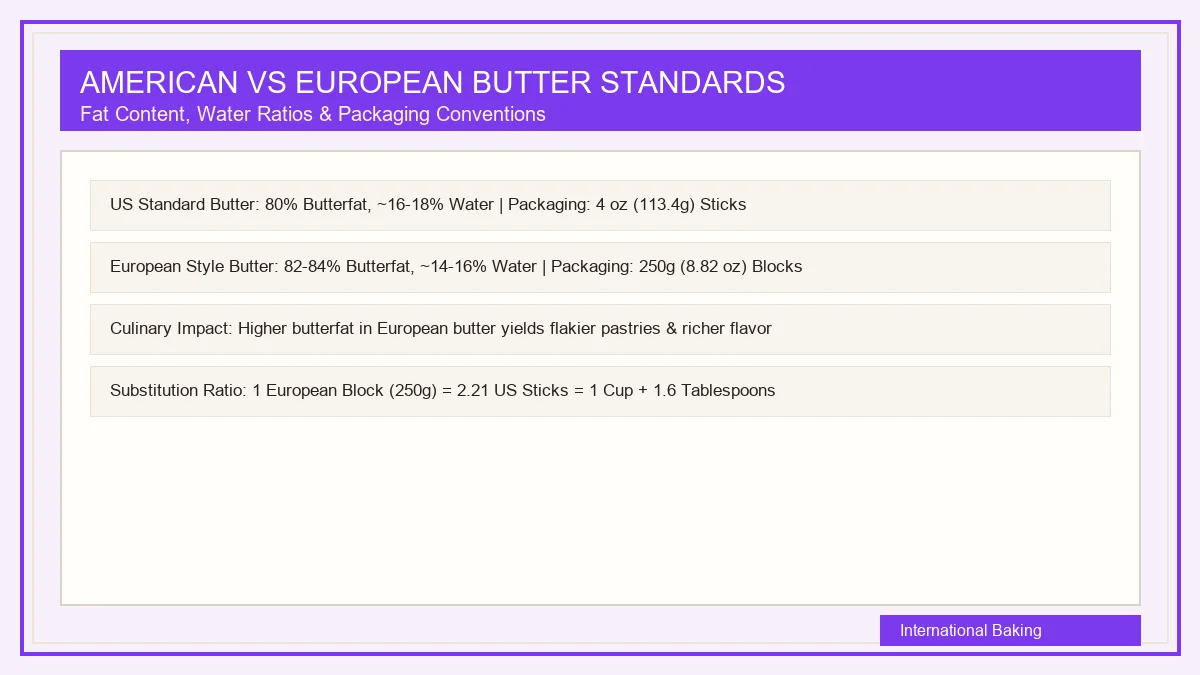
Do not claim European butter cannot be substituted in American recipes. European butter can be substituted 1:1 by weight in most cakes, cookies, and quick breads, yielding a richer flavor and tender crumb.
How to Weigh Butter With a Digital Scale
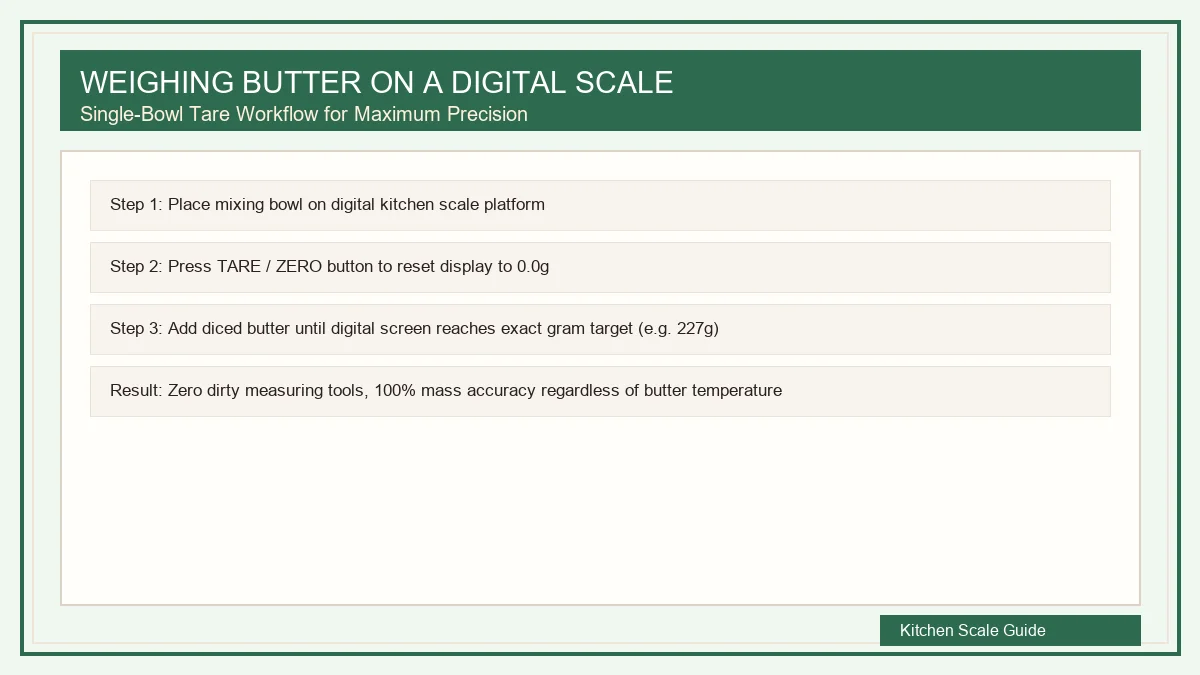
Weighing butter directly on a digital kitchen scale is the single fastest, cleanest way to measure butter for baking. Follow this 4-step workflow:
- Place container on scale: Set your dry mixing bowl, small plate, or piece of parchment wax paper onto the digital scale platform.
- Tare the scale to zero: Press the Tare or Zero button. The scale display will read
0 g, ignoring the container weight. - Slice butter into container: Slice chilled or softened butter directly into the bowl.
- Stop at exact target grams: Watch the digital readout and stop precisely when reaching your recipe's required weight (e.g. 113g for 1 stick or 227g for 1 cup).
For more detailed scale operational guidance, consult our Step-by-Step Guide: How to Use a Digital Kitchen Scale for Baking and explore Why Baking by Weight Is Superior to Measuring by Volume.
Butter Conversion Examples
Here are step-by-step verified mathematical calculations for common real-world butter conversions encountered in recipe scaling:
Example 1: Convert 1 Stick of Butter to Grams
1 Stick * 113.4g = 113.4 grams (Standard rounding: 113g or 113.5g).
Example 2: Convert 2 Sticks of Butter to Grams
2 Sticks * 113.4g = 226.8 grams (Standard rounding: 227g).
Example 3: Convert 3/4 Cup Butter to Grams
0.75 Cups * 226.8g = 170.1 grams (Standard rounding: 170g / 1.5 Sticks).
Example 4: Convert 100 Grams Butter to Cups
100g / 226.8g per cup = 0.441 Cups (Approximately 0.44 Cups or 7 Tablespoons / 0.88 US Sticks).
Example 5: Convert 200 Grams Butter to Cups
200g / 226.8g per cup = 0.882 Cups (Approximately 0.88 Cups or 14.1 Tablespoons / 1.76 US Sticks).
Example 6: Convert 250 Grams Butter to Approximate Cups
250g / 226.8g per cup = 1.102 Cups (Approximately 1.10 Cups or 1 Cup + 1.6 Tablespoons / 2.21 US Sticks / 1 European 250g Block).
For more details on halving or doubling butter quantities in recipes, review our guide: How to Double or Halve a Baking Recipe Without Ruining It.
Common Butter Measurement Mistakes
Steer clear of these seven frequent butter measurement errors that dry out or over-saturate baked goods:
- Confusing Weight Ounces and Fluid Ounces: Assuming 8 ounces of butter by weight (227g) is identical to 8 fluid ounces of liquid (236.6 mL). Butter must be measured by weight mass.
- Assuming All Butter Packages Are US Sticks: Importing European butter blocks (250g) and assuming they are 2 US sticks (227g) adds 23 grams of extra fat to your batter.
- Using Fluid Ounce Cups for Solid Butter: Pressing solid butter into a liquid measuring glass creates huge air pockets and messy cleanup.
- Ignoring Melted vs Softened Wording: Substituting melted butter for softened creamed butter ruins cake aeration and cookie spread structure.
- Rounding Too Aggressively: Rounding 113.4g down to 100g when tripling a recipe introduces a 40-gram fat deficit.
- Confusing Wrapper Markings: Relying on misaligned factory wrapper print lines rather than weighing on a digital scale for pastry dough.
- Using Volume Cups When Recipe Gives Grams: Attempting to scoop butter into measuring cups when a European recipe explicitly provides exact gram weights.
Review more common measurement errors in Top 7 Gram-to-Cup Conversion Mistakes, see our Sugar Conversion Guide, and learn How to Convert Vintage Family Recipes into Modern Gram Weights.
Frequently Asked Questions
1. How many grams are in a stick of butter?
One standard US stick of butter weighs exactly 113.4 grams (commonly rounded in home baking recipes to 113 grams or 113.5 grams).
2. How many cups is one stick of butter?
One standard US stick of butter equals exactly 1/2 US customary cup (0.5 cup or 8 tablespoons).
3. How many tablespoons are in a stick?
There are exactly 8 tablespoons in one standard US stick of butter. Each tablespoon weighs approximately 14.18 grams.
4. How many ounces are in a stick of butter?
One standard US stick of butter weighs 4 ounces by weight (4 oz mass or 1/4 pound).
5. How many grams are in half a stick?
Half a stick of butter (1/4 cup / 4 tablespoons) weighs 56.7 grams (commonly rounded to 57 grams).
6. How many grams are in one cup of butter?
One full cup of butter (2 US sticks) weighs 226.8 grams, which is standardized by King Arthur Baking and USDA data as 227 grams.
7. How do I convert butter grams to cups?
Divide the gram weight of butter by 226.8 (or 227). For example, 100 grams / 226.8 = 0.44 cups (approx 7 tablespoons).
8. How do I convert butter cups to grams?
Multiply the number of US cups by 226.8 (or 227). For example, 3/4 cup * 226.8 = 170.1 grams (170g).
9. Is European butter measured the same way?
European butter comes in 250g blocks rather than 113g sticks and contains higher butterfat (82–84% vs 80%). 1 European block (250g) equals 2.21 US sticks.
10. Should I weigh butter instead of measuring cups?
Yes. Weighing butter in grams on a digital scale is faster, eliminates dirty measuring cups, and avoids volume error caused by air pockets or soft butter sticking to cup walls.
11. How do I measure melted butter?
Measure melted butter in a clear glass liquid measuring cup at eye level on a flat surface, or weigh it directly in grams on a scale.
12. How do I measure softened butter?
Softened butter can be sliced along printed stick wrapper markings (1 tbsp = 14.2g) or sliced directly into a bowl placed on a tared digital scale.
Interactive Butter Sticks & Weight Converter
Convert between sticks, tablespoons, grams, and ounces.
Interactive Baking Calculator Widget
Adjust inputs below for instant real-time recipe formulation.
Need Full Density Reference Tables?
Explore complete g/cup density tables, USDA ratios, and measurement tools.