Top 7 Gram-to-Cup Conversion Mistakes Bakers Make (And How to Fix Them)
"Avoid common grams-to-cups baking mistakes involving density, flour, sugar, cup sizes, and measuring methods with practical fixes."
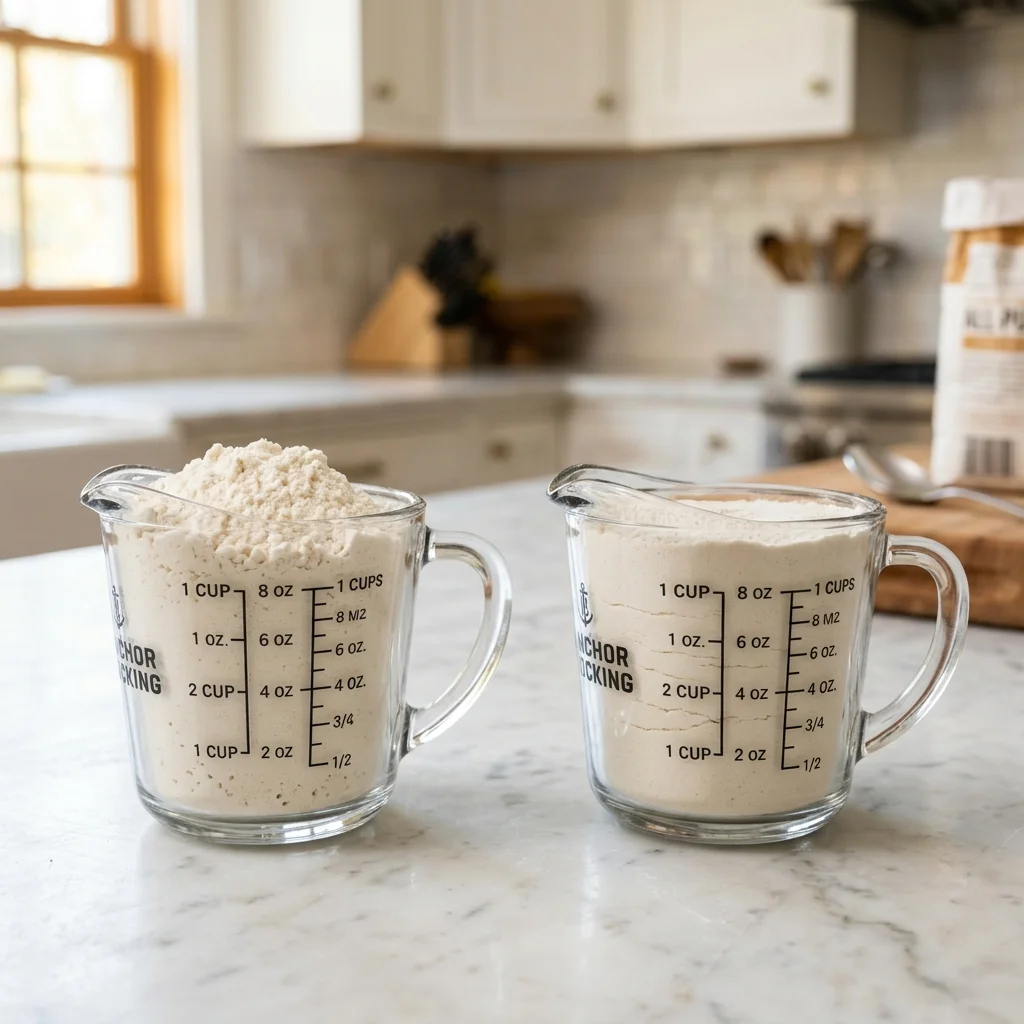
The single biggest mistake home bakers make when converting recipes is assuming there is one universal grams-to-cups conversion factor (such as assuming 1 cup always equals 240 grams).
Because grams measure mass (weight) while cups measure volume (three-dimensional space), the number of grams contained in one cup varies dramatically based on an ingredient's bulk density and physical preparation. Converting 200 grams of flour into cups requires a completely different calculation than converting 200 grams of sugar or butter. Understanding these 7 common conversion errors will save your cakes, cookies, and sourdough bread from common baking failures.
Check sifted sugar metrics in Powdered Sugar Grams to Cups, convert small volume spoons via the Grams to Tablespoons Calculator, or scale ingredient ratios in our Recipe Scaler.
Grams vs Cups: Why the Conversion Is Not Universal
To understand why baking conversions fail, you must first understand the fundamental physical difference between weight and volume:
- Grams (Mass/Weight): Measure the exact physical weight of an ingredient on a digital kitchen scale. One gram of flour weighs exactly the same as one gram of lead or one gram of water.
- Cups (Volume): Measure how much space an ingredient occupies inside a vessel. One US Customary Cup occupies exactly 236.59 milliliters of volume.
Because different ingredients have vastly different physical densities, fill capacities, and air pockets, one cup of volume holds completely different gram weights:
Mistake #1: Using One Conversion Factor for Every Ingredient
A frequent error among beginner bakers is applying a single conversion number (like 240g or 200g) across an entire recipe. For example, assuming 1 cup equals 240 grams across all ingredients will result in using double the necessary flour, turning light cakes into heavy, dry bricks.
Always use ingredient-specific conversion weights. Below is a density comparison chart for common baking ingredients based on standard US Customary Cups:
| Baking Ingredient | 1 US Cup Weight | Preparation Method | Why the Weight Differs |
|---|---|---|---|
| All-Purpose Flour | 120g | Spooned & Leveled | Fluffy particulate structure with significant air trapped between particles |
| Bread Flour | 127g | Spooned & Leveled | Slightly higher protein content increases grain density over AP flour |
| Granulated White Sugar | 200g | Poured & Leveled | Dense sucrose crystals pack tightly together without crushing |
| Brown Sugar (Packed) | 220g | Firmly Packed | Molasses coating allows sugar crystals to be compressed, eliminating air space |
| Unsalted Butter | 227g | Solid Stick (2 sticks) | Solid fat/water emulsion with minimal air content (~0.96 g/mL density) |
| Cocoa Powder | 100g | Spooned & Leveled | Ultra-fine cocoa solid particulates capture large volumes of air |
| Pure Honey / Syrup | 340g | Liquid Poured | High viscous sugar concentration creates heavy density (~1.42 g/mL) |
Mistake #2: Ignoring Ingredient Density
Ingredient density refers to how closely mass is packed within a given volume. In baking science, ingredients fall into three distinct density categories:
- Compressible Dry Powders (Flour, Cocoa Powder, Powdered Sugar): These ingredients easily trap air or pack down tightly. A cup of flour can weigh anywhere from 110g to 150g depending entirely on handling.
- Crystalline Dry Solids (Granulated Sugar, Salt, Oats): These ingredients have rigid structures that do not compress easily under manual pressure.
- Viscous Liquids & Fats (Water, Milk, Honey, Oil, Butter): Liquids occupy volume uniformly without air pockets, but their weights depend on molecular composition (e.g., honey is nearly 45% heavier than water per cup).
Mistake #3: Measuring Flour by Scooping
Scooping a measuring cup directly into a bag or container of flour is the most destructive measuring habit in home baking. Scooping packs the flour against the walls of the cup, forcing out air pockets and adding up to 30 extra grams of flour per cup!
If a recipe calls for 3 cups of flour, scooping will accidentally introduce 450 grams of flour instead of the intended 360 grams. This extra 90 grams of flour (nearly 3/4 cup extra!) causes dense, dry cakes, tough cookies, and heavy bread. To learn proper volume technique, consult our step-by-step guide on How to Measure Flour Correctly.
Mistake #4: Ignoring Packed Brown Sugar
Unlike flour (which must never be packed), brown sugar contains sticky molasses that creates large, irregular air gaps when poured loosely into a measuring cup. Loose brown sugar weighs approximately 145g to 150g per cup.
American recipe developers write recipes assuming brown sugar will be firmly packed into the measuring cup until it holds the shape of the cup when inverted. One cup of firmly packed brown sugar weighs 220 grams. Measuring brown sugar loosely when a recipe assumes packed sugar leads to a 33% shortage in sugar, ruining moisture, spread, and caramelization. Read more details in How to Measure Brown Sugar: Lightly Packed vs Firmly Packed vs Grams.
Mistake #5: Confusing US, Metric, and Imperial Cups
Not all measuring cups are created equal across international borders. If you use a standard US cup for a European, Australian, or vintage British recipe, your conversions will be significantly inaccurate:
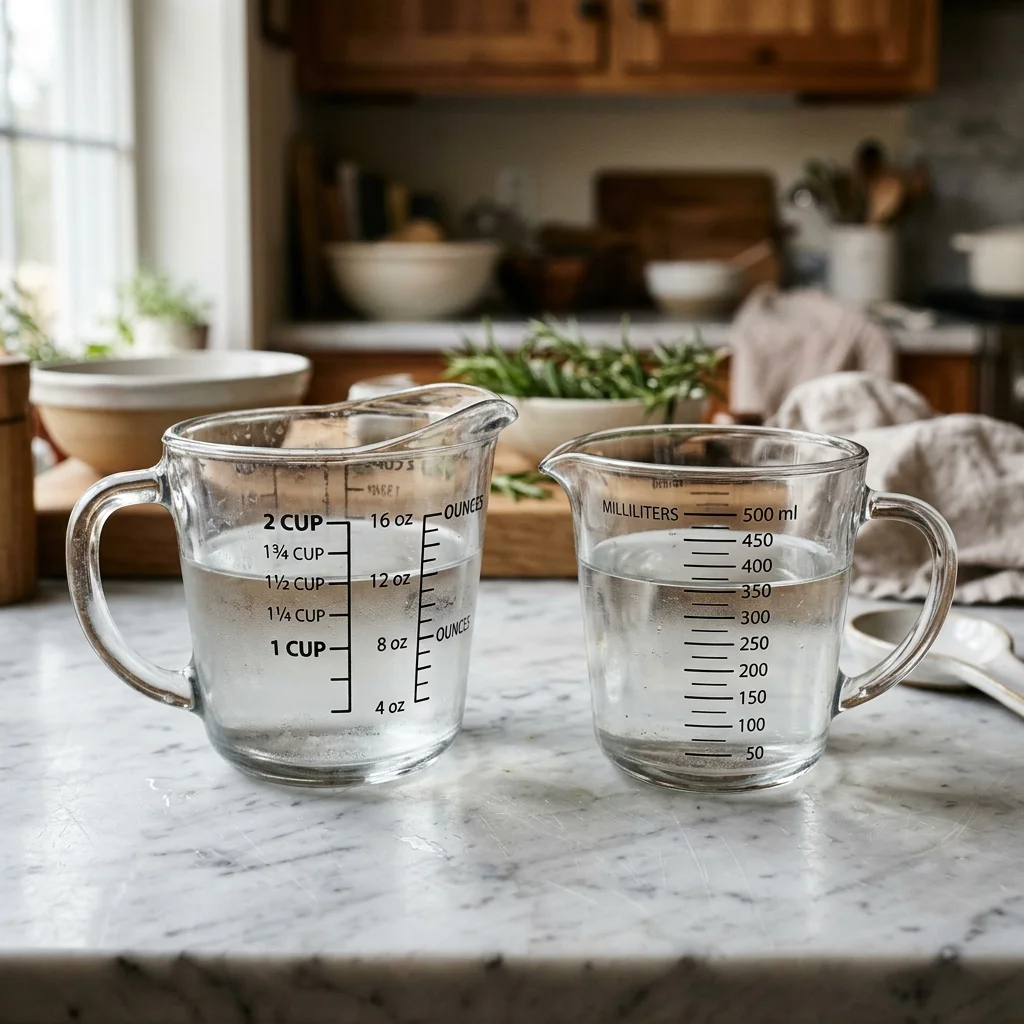
- US Customary Cup: 236.59 mL (8 US fluid ounces), Used in traditional American recipes.
- US Legal Cup (FDA): 240 mL, Used on US commercial nutrition packaging labels.
- Metric Cup: 250 mL, Used in Australia, New Zealand, Canada, and the UK. A metric cup holds 5.6% more volume than a US cup!
- Imperial Cup: 284.13 mL (10 Imperial fluid ounces), Found in UK cookbooks printed before 1977.
To avoid global recipe failure, review our detailed guide on US Cup vs Metric Cup vs Imperial Cup: Volume & Conversion Differences.
Mistake #6: Confusing Weight Ounces With Fluid Ounces
In American cooking, the word "ounce" is dangerously ambiguous because it describes two entirely different measurement systems:
- Weight Ounces (Avoirdupois oz): Measure physical weight (mass) on a kitchen scale. (1 lb = 16 weight ounces).
- Fluid Ounces (fl oz): Measure liquid volume (space). (1 US cup = 8 fluid ounces).
For liquid water, 8 fluid ounces happens to weigh 8 weight ounces (236.5 grams). However, for dry ingredients like flour, 8 fluid ounces of volume (1 cup) only weighs 4.23 weight ounces (120 grams)! Confusing weight ounces with fluid ounces will distort your recipe ratios. For liquid tool selection, see Liquid Measuring Cups vs Dry Measuring Cups: Key Differences Explained.
Mistake #7: Trusting a Random Conversion Chart
If you search online for "1 cup of flour in grams", you will find authoritative websites listing 120g, 125g, 128g, 130g, and even 140g. Why do reputable baking charts disagree?
- Brand Benchmarks: King Arthur Baking benchmarks 1 cup of all-purpose flour at 120 grams (spooned & leveled). The USDA FoodData Central database lists 1 cup of AP flour as 125 grams. Gold Medal Flour lists 1 cup as 130 grams.
- Sifting Status: Sifted flour weighs ~110g per cup, whereas unsifted fluffed flour weighs ~120g, and compact flour weighs ~140g.
- Rounding Rules: Some charts round fractions to the nearest 5g or 10g for convenience.
Rule of Thumb: When a recipe author provides gram measurements alongside cups, always use the author's specified gram weight rather than an external conversion chart.
How to Convert Grams to Cups Correctly
To convert grams into cups accurately, use this simple mathematical formula:
Worked Example: A European recipe calls for 240 grams of All-Purpose Flour. You know that 1 cup of AP flour weighs 120 grams.
240g ÷ 120g/cup = 2.0 US Customary Cups
How to Convert Cups to Grams Correctly
To convert cup quantities into exact gram weights for a digital scale, use this inverse formula:
Worked Example: An American recipe calls for 1.5 cups of Granulated Sugar. You know 1 cup of granulated sugar weighs 200 grams.
1.5 cups × 200g/cup = 300 Grams
When Should You Use Grams Instead of Cups?
While cup measurements are fine for casual cooking, using a digital kitchen scale in grams is essential for high-precision baking:
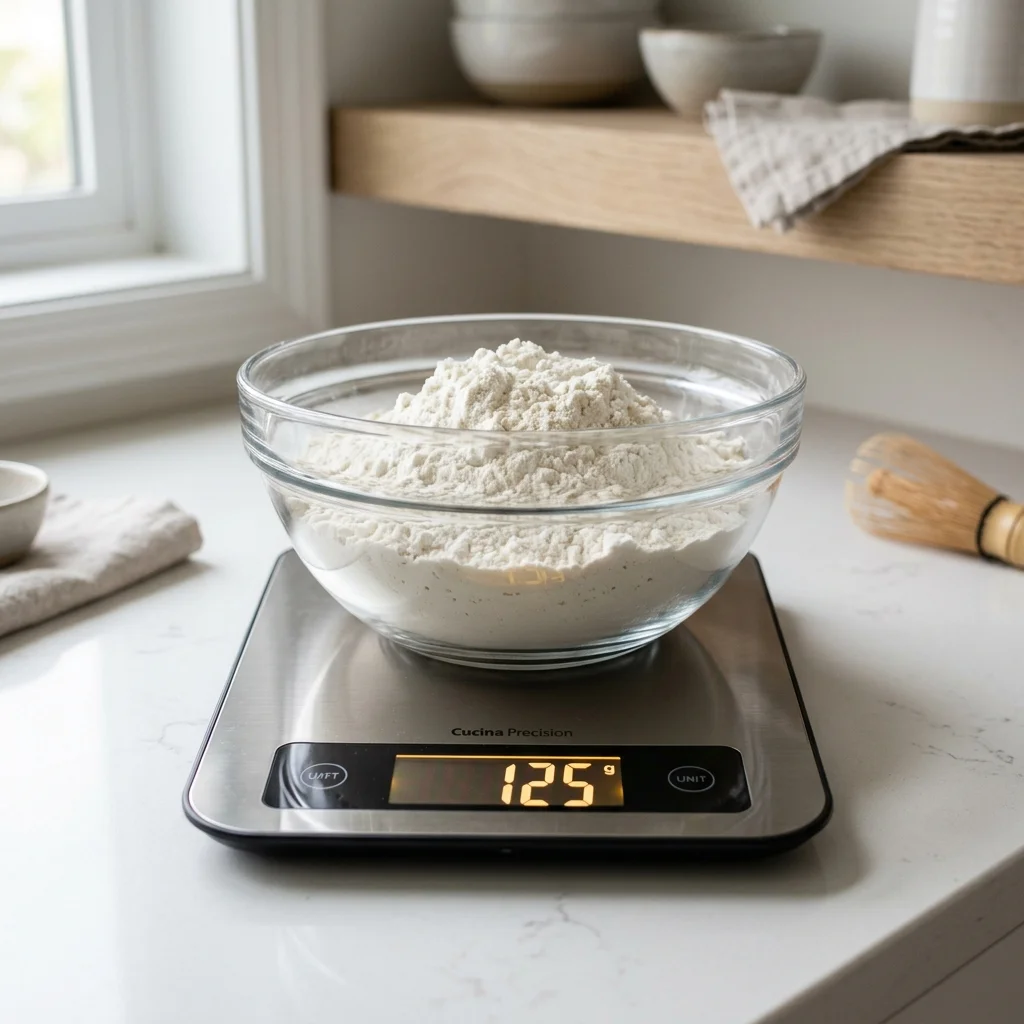
- Precision Pastries & Breads: Macarons, soufflés, sourdough bread, and croissants require exact moisture and gluten balance. Learn more in Why Baking by Weight Is Superior to Measuring by Volume.
- Gluten-Free Substitutions: Gluten-free flours vary wildly in density (e.g., almond flour weighs 96g/cup vs tapioca starch at 120g/cup). See Almond Flour vs All-Purpose Flour: Conversion Ratios and Weight Differences.
- Scaling Recipes: Doubling or tripling a recipe in grams takes seconds on a digital scale without dealing with fractions. See our Step-by-Step Guide: How to Use a Digital Kitchen Scale.
Quick Troubleshooting Table
If your baked goods aren't turning out as expected, use this diagnostic table to fix your conversion errors:
| Baking Problem | Likely Conversion Mistake | How to Fix It |
|---|---|---|
| Cookies dry, cake crumbly | Scooped flour directly from container (added ~25% extra flour weight) | Use digital scale (120g/cup) or fluff & spoon flour into cup |
| Bread dough sticky & wet | Used US Customary Cup (236.5mL) for a Metric Cup (250mL) European recipe | Multiply metric cup recipe by 250mL standard or bake in grams |
| Cake lacks sweetness & spread | Measured brown sugar loosely instead of firmly packing into cup | Firmly pack brown sugar (220g/cup) or weigh on scale |
| Batter too thin or runny | Confused fluid ounces (volume) with weight ounces on scale | Switch digital scale unit to grams or weigh dry ingredients in oz mass |
| Online charts disagree | Different brand density benchmarks (King Arthur 120g vs USDA 125g) | Always prioritize the exact gram weight listed by the recipe author |
The Correct Way to Use a Cups-to-Grams Chart
Follow this 5-step checklist whenever converting volume recipes into mass weights:
- Identify the Exact Ingredient: All-purpose flour (120g) is different from bread flour (127g) or cake flour (114g).
- Identify the Required Preparation: Check whether flour is sifted or unsifted, and whether brown sugar is packed or loose.
- Identify the Cup Standard: Determine if the author wrote the recipe using US Customary Cups (236.59 mL) or Metric Cups (250 mL). For conversion assistance, read How to Bake European Recipes in an American Kitchen.
- Use Verified Conversion Data: Refer to our master reference table in The Master Cups to Grams Baking Conversion Guide.
- Prioritize Recipe-Stated Grams: If a recipe lists both "1 cup flour (125g)", use 125 grams on your digital scale.
Frequently Asked Questions
1. Why are grams to cups conversions different for every ingredient?
Grams measure physical weight (mass), whereas cups measure space (volume). Because ingredients possess different bulk densities, 1 cup of flour weighs 120g, 1 cup of sugar weighs 200g, and 1 cup of honey weighs 340g.
2. How do I convert grams to cups?
Divide the total required grams by the gram weight of 1 cup of that specific ingredient (e.g., 240g flour ÷ 120g/cup = 2 cups).
3. Is 1 cup always the same number of grams?
No. There is no universal grams-per-cup conversion factor. The weight of 1 cup ranges from 100g (cocoa powder) to 340g (honey).
4. How many grams are in 1 cup of flour?
In standard American baking (King Arthur standard), 1 cup of spooned and leveled all-purpose flour weighs 120 grams. The USDA lists 1 cup as 125 grams.
5. Why is flour conversion different from sugar conversion?
Sugar crystals are dense and pack tightly without air gaps (200g/cup). Flour particles are light and capture large amounts of trapped air (120g/cup).
6. Should I weigh flour instead of using cups?
Yes. Weighing flour on a digital scale eliminates volume packing errors that can add up to 30 extra grams per cup when scooping.
7. Are US and metric cups the same?
No. A US Customary Cup is 236.59 mL, whereas a Metric Cup (used in Australia, UK, and Canada) is 250 mL, making metric cups 5.6% larger.
8. What is the difference between ounces and fluid ounces?
Ounces (oz) measure physical weight on a scale, whereas fluid ounces (fl oz) measure volume. 8 fl oz of flour only weighs 4.23 weight ounces.
9. Why do brown sugar conversions use packed measurements?
Brown sugar contains sticky molasses that leaves large air gaps unless firmly pressed into the cup. Packing eliminates air, yielding 220g per cup.
10. Why do different baking charts give different gram weights?
Different institutions use different benchmarks (King Arthur uses 120g for AP flour, USDA uses 125g, Gold Medal uses 130g) based on measuring methods.
11. What is the most accurate way to convert cups to grams?
Multiply the cup amount by the exact gram weight of 1 cup of that ingredient, or use the recipe author's specified gram weight.
12. Can I use one grams-to-cups formula for every ingredient?
No. You must use ingredient-specific conversion values because density varies from 100g/cup (cocoa) to 340g/cup (honey).
Miscalculating packed vs unpacked sugar volume is a common pitfall. Consult our sugar weight conversion guide for exact density metrics.
Interactive Baking Weight Converter
Convert recipe volumes into exact gram weights instantly.
Interactive Baking Weight Converter
Convert recipe volumes into exact gram weights instantly.
Custom package weights override standard database densities for this session without altering official database records.
Need Full Density Reference Tables?
Explore complete g/cup density tables, USDA ratios, and measurement tools.
Related Baking Guides
US Cup vs Metric Cup vs Imperial Cup: The International Baking Guide
Learn the difference between US, metric, and Imperial cups, their milliliter sizes, and how to convert international baking recipes accurately.
Baking ScienceWhy Baking by Weight Is Superior to Measuring by Volume
Learn why weighing baking ingredients in grams is more accurate than cups, how density affects volume, and how a kitchen scale improves consistency.
Baking ScienceHow to Bake European Recipes in an American Kitchen
Learn how to convert European baking recipes for an American kitchen, including grams, milliliters, Celsius, gas marks, cups, and ingredient weights.