How to Convert Vintage Family Recipes into Modern Gram Weights
"Learn how to convert vintage family recipes to grams, including scant cups, heaping spoons, old-fashioned butter measurements, and vague quantities."
Converting an old family recipe card into modern gram weights is like translating a historical document.
Handwritten heirloom recipes often contain archaic measurement phrases that made complete sense to the original cook but present major hurdles today: “a scant cup of flour,” “a heaping tablespoon of lard,” “butter the size of an egg,” “one coffee cup of milk,” or simply “flour enough to make a soft dough.” The goal when modernizing a vintage recipe is not to rewrite it blindly with false precision, but to preserve the original culinary intent while documenting reasonable modern gram weight ranges and recording your level of uncertainty.
Convert butter sticks and knobs with our Butter Converter, translate old-fashioned spoon measurements using the Grams to Tablespoons Calculator, or resize family batches with the Recipe Scaler.
Why Vintage Recipes Are Hard to Convert
Prior to Fannie Farmer’s landmark 1896 Boston Cooking-School Cook Book, standardized volumetric measuring cups did not exist in American household kitchens. 19th-century bakers relied on whatever teacups, coffee cups, or tin dippers were in their kitchen cabinets. Furthermore, historical recipes present several distinct conversion challenges:
- Non-Standardized Household Vessels: An 1870 "coffee cup" held roughly 6 fluid ounces (180 mL), whereas a modern US customary cup holds 8 fluid ounces (240 mL).
- Variable Ingredient Densities: Historical flour was unrefined and coarsely milled, while farm butter varied in moisture content depending on the season.
- Visual and Physical Benchmarks: Cooks relied on comparisons to familiar household items (eggs, walnuts, nutmegs) rather than precise weights.
- Uncalibrated Wood-Burning Stoves: Ovens had no thermostats; heat was described subjectively as "slow," "moderate," or "quick."
The Golden Rule: Research the Original Source First
Before assigning gram weights to a vintage recipe, investigate its historical context by following these six research steps:
- Identify the Cookbook or Era: Determine the publication year or handwritten date (e.g. Victorian era, Great Depression, mid-century).
- Check Introductory Measurement Notes: Many 19th-century cookbooks included an introductory chapter defining how the author measured ingredients.
- Inspect Surrounding Recipes: Check adjacent recipes in the same manuscript for proportion clues (e.g. liquid-to-flour ratios).
- Determine Regional Context: American, British, and European recipes used completely different historical volume standards. Learn how volume evolved in our guide: What Is a 'Cup' Measurement? History and Evolution of Culinary Volume.
- Look for Author Definitions: Note whether the author explicitly stated that all cups should be measured level or rounded.
- Preserve Original Wording: Always record the exact historical text before creating a modernized version.
What Does “Scant Cup” Mean?
A scant cup means slightly less than a full, level measuring cup, roughly 7/8 of a cup (or 14 level tablespoons instead of 16 tablespoons).
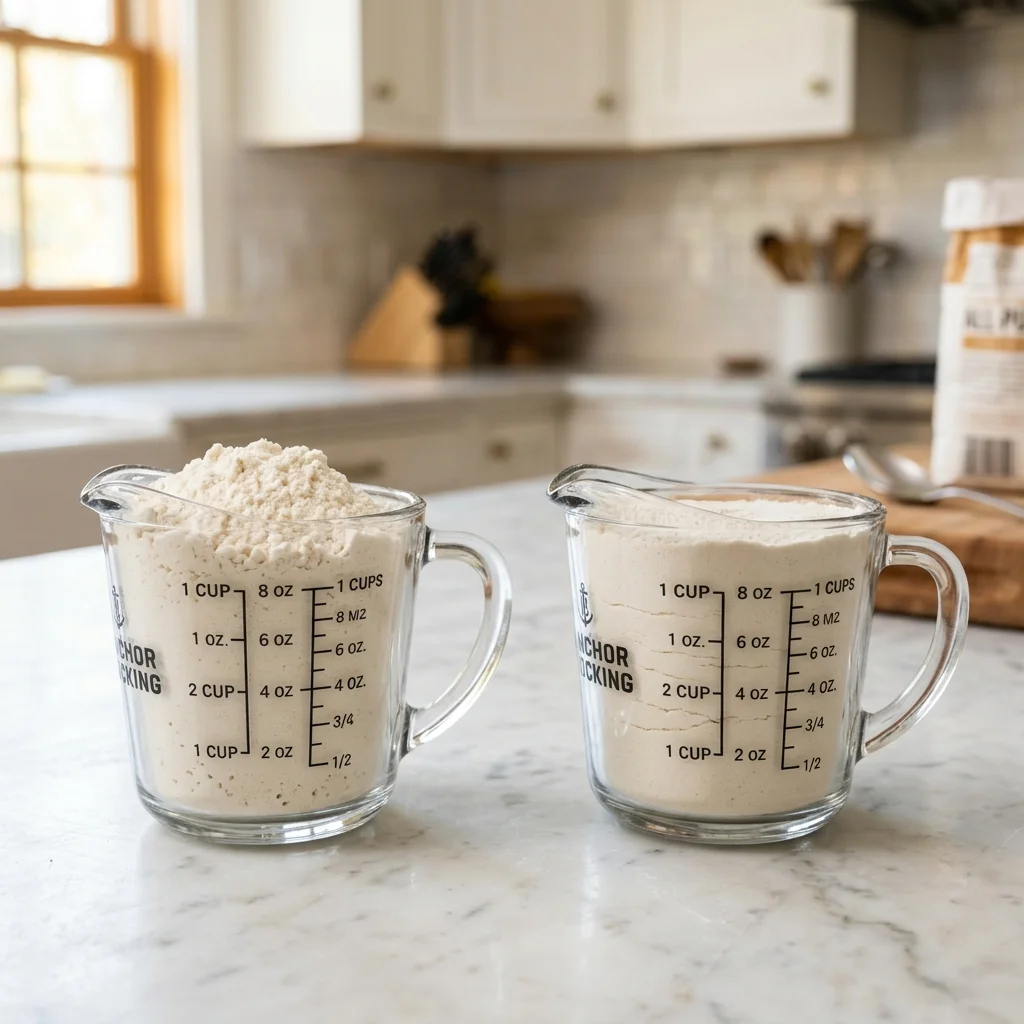
- Scant Cup of Flour: Approximately 105g to 110g (compared to 120g for a standard level cup).
- Scant Cup of Sugar: Approximately 175g (compared to 200g for a standard level cup).
- Scant Cup of Liquid: Approximately 210g / 210 mL (compared to 240g / 240 mL).
- Confidence Level: High / Medium, Historical context indicates bakers filled the cup about 1/2 inch below the rim.
What Does “Heaping” or “Generous” Mean?
Historical recipe writers used descriptive terms to modify volume measures:
- Heaping (or Heaped) Spoon / Cup: As much ingredient as can be piled onto the spoon or cup without falling off (adds 25% to 50% extra volume). A heaping tablespoon of flour weighs ~15g to 18g (vs 9g level).
- Generous Cup: Filled to overflowing slightly above the rim (adds roughly 10% to 15% extra volume; ~135g flour).
- Rounded Spoon: Domed slightly above the edge, equal to about 1.5 level tablespoons.
- Level: Scraped completely flat across the top rim with a straight edge.
What Does “Butter the Size of an Egg” Mean?
The phrase “butter the size of an egg” appears frequently in 19th-century American recipes. Because chicken eggs in the 1800s were slightly smaller than modern USDA Large eggs, historical food researchers estimate this phrase meant approximately 1/4 cup of butter (4 tablespoons / 2 ounces / 50g to 57g).
| Historical Phrase | Historical Context | Modern Conversion Approach | Confidence Level |
|---|---|---|---|
| Butter the size of an egg | ~1/4 US cup (4 tbsp / 2 oz) | 50g to 57g butter | Medium (Context-dependent) |
| Butter the size of a walnut | ~1 to 1.5 tablespoons | 14g to 20g butter | Medium |
| Butter the size of a nutmeg | ~1 teaspoon | 5g to 7g butter | Medium |
| Butter the size of a hen's egg | ~1/4 US cup | 50g to 55g butter | Medium |
What Does “Butter the Size of a Walnut” Mean?
“Butter the size of a walnut” refers to an unshelled walnut, representing roughly 1 tablespoon to 1.5 tablespoons of butter (14 grams to 20 grams).
Coffee Cup, Teacup and Tumbler
Before volumetric standardization, recipes specified specific household drinking vessels:
- Coffee Cup: Held approximately 6 fluid ounces (180 mL). Converting a vintage 1-coffee-cup recipe directly to a 240 mL modern US cup adds 33% extra liquid or flour! Explore regional cup differences in US Cup vs Metric Cup vs Imperial Cup: What’s the Difference?.
- Teacup: Held approximately 4 to 5 fluid ounces (120 mL to 150 mL).
- Tumbler: A standard drinking glass holding about 8 fluid ounces (240 mL), closest to the modern US cup.
Saltspoon, Pinch and Dash
Micro-measurements in Victorian recipes rely on small spoons and hand gestures:
- Saltspoon: A tiny miniature spoon equal to 1/4 teaspoon (~1.5g table salt or 0.6g baking soda).
- Pinch: What you can pick up between your thumb and index finger, roughly 1/16 teaspoon (~0.3g salt).
- Dash: Used for liquid extracts, roughly 1/8 teaspoon (~0.6 mL).
“Flour Enough” and Other Vague Instructions
Instructions like “flour enough to make a stiff dough” or “milk enough to moisten” require technique-based interpretation. When testing a vintage recipe:
- Place your mixing bowl on a digital scale and zero the scale (press Tare).
- Add flour incrementally while kneading or stirring until the desired dough texture is achieved.
- Note the exact total grams added on your scale to establish a repeatable baseline weight.
How to Convert Vintage Flour Measurements to Grams
To convert vintage flour measurements into precise grams, follow these seven steps:
- Identify the specified volume (e.g. 2 cups).
- Determine flour type (vintage recipes usually meant soft unbleached all-purpose flour).
- Check if the recipe calls for flour to be sifted before or after measuring.
- Account for measuring technique (1 cup sifted flour = 115g; 1 cup spooned flour = 120g; 1 cup scooped flour = 140g). See our guide on How to Measure Flour Correctly.
- Select your modern reference weight (e.g. 120g/cup).
- Document your conversion assumption in a notebook.
- Weigh the flour on your digital scale.
How to Convert Vintage Sugar Measurements
Sugar in vintage recipes was coarsely granulated or sold in loaves that had to be pounded. For modern conversion: 1 cup modern granulated sugar = 200 grams. For brown sugar instructions, check How to Measure Brown Sugar: Lightly Packed vs Firmly Packed vs Grams.
How to Convert Vintage Butter Measurements
Vintage recipes express butter in sticks, cups, or physical benchmarks. Refer to Liquid Measuring Cups vs Dry Measuring Cups: Are They Interchangeable? to ensure accurate butter density measurements (1 US cup butter = 227g / 8 oz / 2 sticks).
How to Convert Vintage Oven Instructions
Wood-burning and coal stoves had no temperature dials. Use this standard temperature interpretation key:
| Vintage Oven Term | Fahrenheit Range | Celsius Range | Typical Baking Application |
|---|---|---|---|
| Slow Oven | 275°F – 325°F | 135°C – 165°C | Fruitcakes, meringues, custards |
| Moderate Oven | 350°F – 375°F | 175°C – 190°C | Cakes, cookies, quick breads |
| Hot / Quick Oven | 400°F – 425°F | 200°C – 220°C | Yeast breads, biscuits, pastry crusts |
| Very Hot Oven | 450°F – 500°F | 230°C – 260°C | Popovers, roasting, pizza |
How to Convert Vintage Pan Instructions
Vintage recipes often specify vague pan descriptions like “a shallow earthenware dish” or “a tin pie plate.” Check surface area capacity using our Baking Pan Conversion Chart to choose an appropriate modern 8x8-inch square pan or 9-inch round pan.
How to Document Your Modernized Recipe
When converting vintage family recipes, document your modernized version alongside the original using this transparent 4-field structure:
Do Not Erase the Original Recipe
Keep your grandmother's or great-grandmother's original handwritten card intact! Preserving the historical text alongside your modern gram weights preserves family heritage while ensuring consistent baking results for future generations.
Example: Converting a Vintage Family Cake
Below is an illustrative example of modernizing an 1890s handwritten vanilla cake recipe:
| Ingredient | Original Wording | Modern Weight | Confidence | Conversion Rationale |
|---|---|---|---|---|
| Flour | 2 cups flour | 240g | High | 2 × 120g spooned AP flour |
| Sugar | scant cup sugar | 175g | Medium | 7/8 cup granulated sugar (200g × 0.875) |
| Butter | butter size of an egg | 55g | Medium | ~1/4 cup (4 tbsp / 2 oz) butter benchmark |
| Leavening | 1 heaping tsp baking powder | 6g | Medium | 1 level tsp (4g) + 50% dome = 6g |
| Liquid | milk enough to make batter | 180g (3/4 cup) | Inferred | Weighed incrementally until smooth cake batter formed |
Vintage Recipe Conversion Worksheet
Use this practical reference template when modernizing your own family recipes:
| Original Wording | Ingredient Category | Modern Interpretation | Gram Estimate | Confidence |
|---|---|---|---|---|
| 1 scant cup flour | Dry Ingredient | 7/8 cup spooned flour | 105g | High |
| 1 heaping tbsp flour | Dry Ingredient | 1.5 level tablespoons | 15g | Medium |
| Butter size of egg | Fat / Solid | 1/4 cup (4 tbsp / 2 oz) | 50g–57g | Medium |
| 1 coffee cup milk | Liquid | 6 fluid ounces (180 mL) | 180g | Medium |
| 1 saltspoon salt | Seasoning | 1/4 teaspoon | 1.5g | High |
Common Vintage Recipe Conversion Mistakes
Avoid these frequent mistakes when converting old recipes:
- Treating Historical Measures as Modern Standards: Assuming an 1850 "coffee cup" is identical to a modern 240 mL US cup.
- Assuming Egg-Sized Butter Is Exact: Presenting 50g as a universal truth rather than a context-dependent estimate.
- Ignoring Cookbook Notes: Failing to read the author's intro notes regarding measuring methods.
- Replacing Vague Terms with Invented Precision: Writing down "123.4g" when the original author said "flour enough."
- Measuring by Volume Instead of Weight: Review Step-by-Step Guide: How to Use a Digital Kitchen Scale, Why Baking by Weight Is Superior to Measuring by Volume, The Master Cups to Grams Baking Conversion Guide, and Top 7 Gram-to-Cup Conversion Mistakes Bakers Make (And How to Fix Them).
Frequently Asked Questions
1. What does a scant cup mean in an old recipe?
A scant cup means slightly less than a full level cup, approximately 7/8 cup (14 tablespoons), or about 105g to 110g of flour.
2. What does a heaping spoon mean?
A heaping spoon is piled as high as ingredient will sit on the spoon without spilling, adding roughly 25% to 50% extra weight.
3. How much is butter the size of an egg?
Butter the size of an egg refers to roughly 1/4 cup of butter (4 tablespoons / 2 ounces), or approximately 50g to 57g.
4. How much is butter the size of a walnut?
Butter the size of an unshelled walnut equals about 1 to 1.5 tablespoons of butter, or approximately 14g to 20g.
5. What is a saltspoon in old recipes?
A saltspoon is a small miniature antique spoon equal to 1/4 teaspoon (approx 1.5 grams of salt).
6. What is a coffee cup in an old recipe?
An antique 19th-century coffee cup held about 6 fluid ounces (180 mL), whereas a modern US cup holds 8 fluid ounces (240 mL).
7. How do I convert an old family recipe to grams?
Identify the historical era, translate vague descriptors into approximate volume, weigh ingredients on a scale while testing, and record total grams.
8. Can old recipes be converted accurately?
Yes, by using technique-based testing on a digital scale and documenting assumptions alongside confidence levels.
9. How do I convert vintage flour measurements?
Assume 120g per spooned cup of all-purpose flour, adjusting down for sifted flour (115g) or scant cups (105g).
10. How do I convert 'flour enough'?
Zero your mixing bowl on a scale, add flour gradually until proper dough consistency is reached, and record the exact gram weight.
11. What does a slow oven mean in an old recipe?
A slow oven corresponds to a modern temperature of 275°F to 325°F (135°C to 165°C), used for slow-baking cakes and custards.
12. Should I preserve the original recipe wording?
Always preserve original text alongside your modern gram conversion to maintain family history and research clarity.
Translating vintage volumetric terms requires verified reference charts. Utilize our butter conversion master table, sugar conversion guide, history of cup measurements, and master cups to grams conversion guide.
Interactive Baking Weight Converter
Convert recipe volumes into exact gram weights instantly.
Interactive Baking Weight Converter
Convert recipe volumes into exact gram weights instantly.
Custom package weights override standard database densities for this session without altering official database records.
Need Full Density Reference Tables?
Explore complete g/cup density tables, USDA ratios, and measurement tools.
Related Baking Guides
US Cup vs Metric Cup vs Imperial Cup: The International Baking Guide
Learn the difference between US, metric, and Imperial cups, their milliliter sizes, and how to convert international baking recipes accurately.
Baking ScienceWhy Baking by Weight Is Superior to Measuring by Volume
Learn why weighing baking ingredients in grams is more accurate than cups, how density affects volume, and how a kitchen scale improves consistency.
Baking ScienceHow to Bake European Recipes in an American Kitchen
Learn how to convert European baking recipes for an American kitchen, including grams, milliliters, Celsius, gas marks, cups, and ingredient weights.