The Master Cups to Grams Baking Conversion Guide
"Convert cups to grams for common baking ingredients with practical charts for flour, sugar, butter, cocoa, liquids, and more."
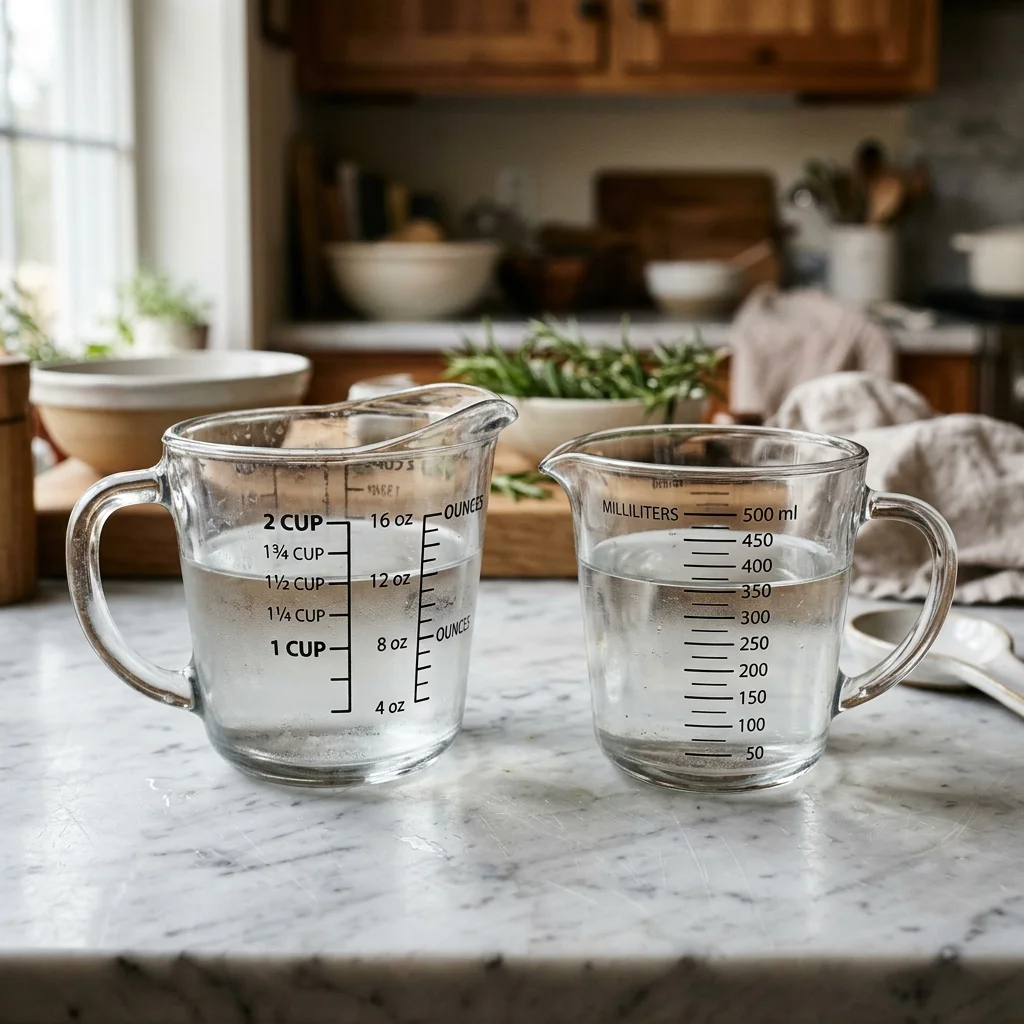
Home bakers frequently search for a single, universal formula to convert cups to grams. The direct answer is there is no single conversion factor for every ingredient. A cup measures volume (space occupied), whereas grams measure mass (weight). Because different ingredients have different bulk densities, 1 cup of flour weighs 125 grams, 1 cup of granulated sugar weighs 200 grams, 1 cup of butter weighs 227 grams, and 1 cup of honey weighs 340 grams.
This master guide serves as the definitive reference index for converting recipes between volume cups and metric weight grams. Compiled using verified density data from USDA FoodData Central and King Arthur Baking test kitchen standards, this guide provides exact conversion tables, fraction breakdowns, mathematical formulas, international cup comparisons, and practical measuring rules to ensure your bakes turn out perfectly every time.
Convert butter sticks with the Butter Converter, look up small measurements in the Tablespoons to Grams Calculator, or multiply batch yields with our Recipe Scaler.
Cups vs Grams: Why There Is No Universal Conversion
The fundamental reason volume-to-weight conversions vary across ingredients comes down to bulk density (specific gravity):
- Volume (Cups, Milliliters, Fluid Ounces): Measures how much three-dimensional space an ingredient occupies inside a measuring vessel.
- Mass (Grams, Ounces, Kilograms): Measures the actual quantity of matter (weight) regardless of pan shape or air pockets.
Consider four common kitchen ingredients filled to the top of the exact same 1 US Customary Cup (236.59 ml):
All-Purpose Flour
125g
Low density, fluffy starch
Granulated Sugar
200g
Crystalline structure
Butter (Softened)
227g
Solid fat emulsion (2 sticks)
Liquid Honey
340g
Dense, viscous liquid
Measurement Methodology & Data Standards
To maintain absolute consistency across our conversion tools, all weights in this guide adhere to the following standardized baseline parameters:
- Cup Volume Standard: 1 US Customary / Legal Cup = 240 ml (236.59 ml exact customary).
- Flour Measurement Technique: Fluffed, spooned into measuring cup, and leveled off with a straight knife edge (never dip-scooped).
- Brown Sugar Standard: Lightly pressed or firmly packed into dry measuring cup as specified in recipe text.
- Data Verification Sources: Cross-verified using USDA FoodData Central density standards and King Arthur Baking test kitchen references.
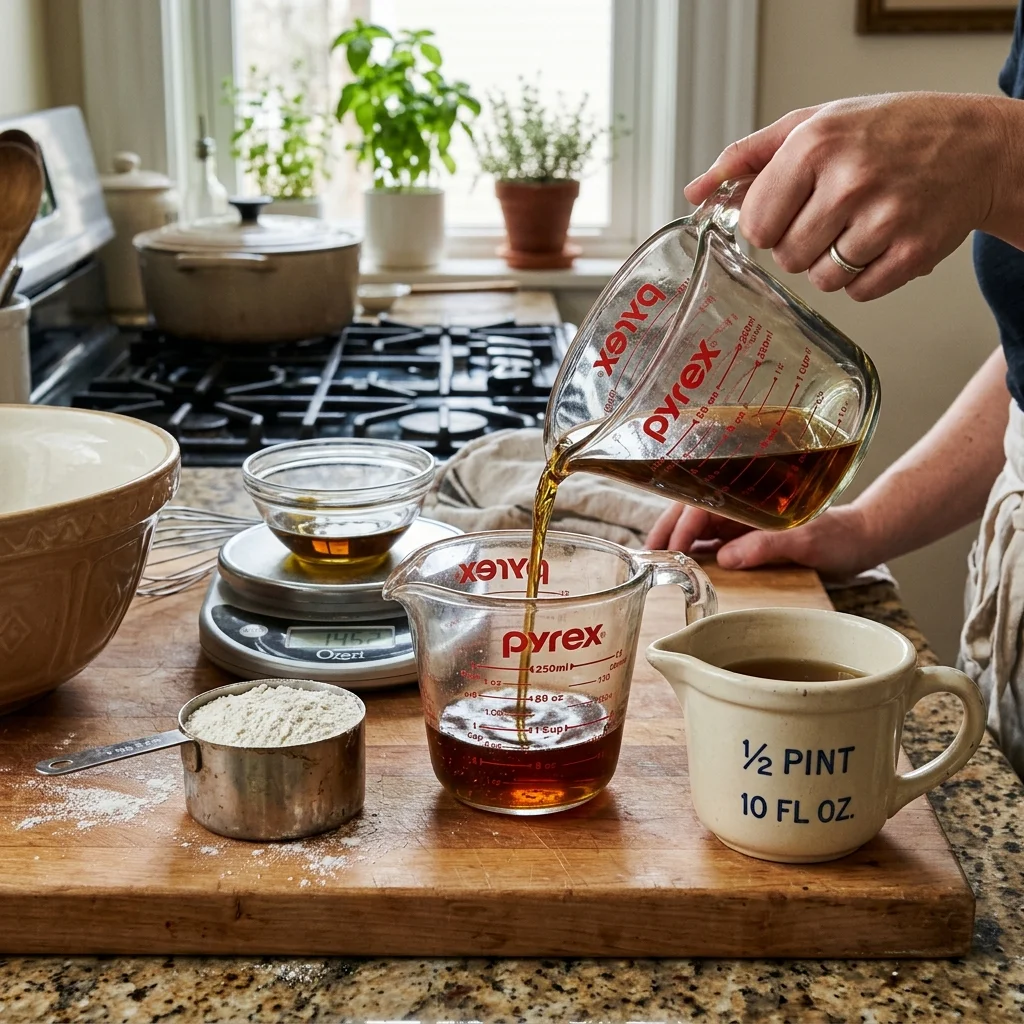
Master Cups to Grams Baking Conversion Chart
The master lookup table below provides standard conversions for 30+ core baking ingredients from 1 US Cup to Grams, Metric Cups, Tablespoons, and measuring techniques:
| Ingredient | 1 US Cup (g) | 1 Metric Cup (g) | 1 Tbsp (g) | Standard Measuring Technique |
|---|---|---|---|---|
| All-Purpose Flour | 125g | 130g | 7.8g | Spoon into cup & level flat |
| Bread Flour | 130g | 135g | 8.1g | Spoon into cup & level flat |
| Cake Flour | 115g | 120g | 7.2g | Sift or spoon lightly into cup |
| Whole Wheat Flour | 120g | 125g | 7.5g | Spoon into cup & level gently |
| Almond Flour (Blanched) | 112g | 117g | 7.0g | Spoon lightly without packing |
| Coconut Flour | 128g | 133g | 8.0g | Spoon gently & level knife |
| Granulated White Sugar | 200g | 208g | 12.5g | Pour directly into cup & level |
| Packed Brown Sugar | 220g | 229g | 13.8g | Pack firmly into measuring cup |
| Loose Brown Sugar | 180g | 188g | 11.3g | Spoon loosely without pressing |
| Powdered Sugar (Unsifted) | 120g | 125g | 7.5g | Spoon into cup & level (100g sifted) |
| Butter (2 Sticks) | 227g | 236g | 14.2g | Press softened fat or stick marks |
| Melted Butter (Liquid) | 218g | 227g | 13.6g | Pour into liquid measuring cup |
| Unsweetened Cocoa Powder | 85g | 89g | 5.3g | Sift or spoon into cup gently |
| Cornstarch | 112g | 117g | 7.0g | Spoon gently & level knife flat |
| Rolled Oats (Old-Fashioned) | 90g | 94g | 5.6g | Scoop into cup & level gently |
| Semisweet Chocolate Chips | 170g | 177g | 10.6g | Pour into cup until level |
| Whole Milk (3.25%) | 245g | 255g | 15.3g | Pour into liquid cup at eye level |
| Water | 236.6g | 250g | 14.8g | Pour into liquid jug at eye level |
| Heavy Whipping Cream | 238g | 248g | 14.9g | Pour into liquid jug at eye level |
| Liquid Honey | 340g | 354g | 21.3g | Pour liquid honey into cup |
| Pure Maple Syrup | 322g | 335g | 20.1g | Pour liquid syrup at eye level |
Flour Cups to Grams Breakdown
Flour density varies significantly depending on wheat variety, protein percentage, and grinding fineness:
- All-Purpose Flour (125g/cup): General purpose wheat flour with 10–12% protein. Master measuring techniques in How to Measure Flour Correctly: Spoon and Level Method vs Scooping.
- Bread Flour (130g/cup): Dense hard wheat flour with 12–14% protein. Explore bread formulas in Artisan Bread Baking: Understanding Baker's Percentages and Gram Weights.
- Cake Flour (115g/cup): Soft wheat flour bleached to produce tender crumbs.
- Almond Flour (112g/cup): Finely ground blanched almonds. Learn substitution ratios in Almond Flour vs All-Purpose Flour: Conversion Ratios and Weight Differences.
Sugar Cups to Grams Breakdown
Sugar weight is determined by crystal size and moisture packing state:
- Granulated White Sugar (200g/cup): Free-flowing crystals that pour cleanly without packing.
- Packed Brown Sugar (220g/cup): Contains molasses syrup. Packing eliminates air gaps, raising weight from 180g (unpacked) to 220g (packed). Read our detailed guide: How to Measure Brown Sugar: Lightly Packed vs Firmly Packed vs Grams and Sugar Conversion Guide.
- Powdered Confectioners Sugar (120g unsifted / 100g sifted): Fine sugar dust that traps air when sifted.
Butter & Fats Cups to Grams Breakdown
Butter in North America is sold in standardized sticks, making volume-to-weight conversions straightforward:
1 US Cup Butter = 2 sticks = 16 tablespoons = 8 oz = 227 grams
3/4 Cup Butter = 1.5 sticks = 12 tablespoons = 6 oz = 170 grams
1/2 Cup Butter = 1 stick = 8 tablespoons = 4 oz = 113 grams
1/4 Cup Butter = 1/2 stick = 4 tablespoons = 2 oz = 57 grams
1 Tablespoon Butter = 0.5 oz = 14.2 grams
Explore complete fat conversions in our Butter Conversion Master Table: Sticks to Grams to Cups to Ounces.
Liquid Ingredients: Viscosity and Specific Gravity
In metric water measurement, 1 milliliter of pure water equals exactly 1 gram. However, liquid baking ingredients have distinct specific gravities:
- Water: 1 US Cup = 236.6 ml = 236.6g (1.0 g/ml density).
- Whole Milk: 1 US Cup = 245g (1.03 g/ml density due to dissolved milk sugars & proteins).
- Liquid Honey: 1 US Cup = 340g (1.42 g/ml density). Honey is 42% denser than water!
- Pure Maple Syrup: 1 US Cup = 322g (1.34 g/ml density).
Cocoa Powder, Leaveners, and Spices
Small quantity leaveners and cocoa powders require careful measuring:
- Cocoa Powder (85g/cup): Highly aerated powder. Read Dutch Process vs Natural Cocoa Powder: Weight, Sifting, and Acid Balance.
- Baking Powder (192g/cup): 1 tsp = 4.0 grams.
- Baking Soda (220g/cup): 1 tsp = 4.6 grams.
- Fine Table Salt (292g/cup): 1 tsp = 6.1 grams. Kosher salt flakes vary drastically (Diamond Crystal = 140g/cup; Morton = 220g/cup).
Common Cup Fractions to Grams Matrix
The table below provides exact gram weight breakdowns across common recipe cup fractions for 6 essential baking ingredients:
| Cup Fraction | AP Flour | Granulated Sugar | Packed Brown Sugar | Butter | Almond Flour | Honey |
|---|---|---|---|---|---|---|
| 1 Cup | 125g | 200g | 220g | 227g | 112g | 340g |
| 3/4 Cup | 94g | 150g | 165g | 170g | 84g | 255g |
| 2/3 Cup | 83g | 133g | 147g | 151g | 75g | 227g |
| 1/2 Cup | 63g | 100g | 110g | 113g | 56g | 170g |
| 1/3 Cup | 42g | 67g | 73g | 76g | 37g | 113g |
| 1/4 Cup | 31g | 50g | 55g | 57g | 28g | 85g |
| 1/8 Cup (2 tbsp) | 16g | 25g | 28g | 28g | 14g | 43g |
How to Convert Cups to Grams Yourself
To convert cups to grams for any recipe ingredient, use this basic mathematical formula:
Formula: Grams = Number of Cups * Grams per Cup for Ingredient
Calculation Example: You want to convert 2.5 cups of All-Purpose Flour into grams.
1 US Cup AP Flour = 125 grams.
2.5 * 125 = 312.5 grams (round to 313 grams)
How to Convert Grams Back to Cups
To convert a metric gram recipe back into volume cups, invert the formula:
Formula: Cups = Total Grams / Grams per Cup for Ingredient
Calculation Example: A European recipe calls for 400 grams of Granulated Sugar.
1 US Cup Granulated Sugar = 200 grams.
400 / 200 = 2.0 US Customary Cups
US Cup vs Metric Cup vs Imperial Cup Standards
Measuring cup volumes differ depending on the country of origin. Read our dedicated guide: US Cup vs Metric Cup vs Imperial Cup: The International Baking Guide.
US Customary / Legal Cup
Volume: 236.59 ml (Legal: 240 ml). Standard in American home kitchens and US recipe books.
Metric Cup
Volume: 250 ml. Standard in Australia, New Zealand, Canada, and parts of Europe (6% larger than US cup).
Imperial Cup (UK Vintage)
Volume: 284.13 ml. Found in older British and Commonwealth family cookbooks (20% larger than US cup).
Why Weighing Is Better for Precision Baking
Switching from volume cups to a digital kitchen scale elevates baking consistency drastically. Read our full analysis in Why Baking by Weight Is Superior to Measuring by Volume.
- Eliminates Volume Density Errors: Scooping flour with a volume cup can pack up to 140g–150g per cup (20% extra flour), making cakes dense and rubbery.
- Fewer Dirty Dishes: Weigh ingredients directly into your mixing bowl using the tare function.
- Perfect Recipe Scaling: Doubling or halving gram weights is mathematically exact.
How Measurement Technique Changes Conversion Accuracy
How you fill a measuring cup creates significant weight variations:
- Spoon and Level Method (Standard): Fluff flour, spoon it into cup, and sweep flat with a knife edge = 120g–125g.
- Dip and Sweep Method: Dipping cup straight into a tight flour bag packs flour down = 140g–150g (+20% error).
- Sifted Flour: Sifting flour before measuring traps air = 100g–110g (-15% weight).
- Packed Brown Sugar: Firm packing forces out air gaps = 220g (versus 180g loose).
When Should You Use a Kitchen Scale?
A digital scale is essential when baking delicate recipes like French macarons, soufflés, sourdough bread, and high-hydration artisan loaves. Find top kitchen scale recommendations in Top 5 Best Kitchen Digital Scales for Baking Precision in 2026.
How to Convert an International Recipe
When executing international recipes in an American kitchen, follow this 5-step checklist:
- Identify Recipe Country of Origin: Determine if the author uses UK, European, Australian, or US conventions. Learn more in How to Bake European Recipes in an American Kitchen.
- Identify Cup Standard: 250ml Metric cup vs 236.6ml US cup.
- Lookup Ingredient Gram Density: Match ingredient to our master table above.
- Convert Oven Temperature: Convert Celsius (°C) to Fahrenheit (°F). (e.g. 180°C = 350°F).
- Test Bakers Ratios: Practice exact metric baking in recipes like Ultimate Chocolate Chip Cookie Recipe by Weight and Moist Metric Banana Bread Recipe.
10 Most Common Cups-to-Grams Conversion Mistakes
Avoid these ten frequent conversion traps:
- Using One Single Conversion Factor for All Ingredients: Assuming 1 cup = 200g for every dry ingredient creates disaster.
- Treating a Volume Cup as a Weight Ounce: Confusing fluid ounces (volume) with dry weight ounces.
- Ignoring Packed Brown Sugar State: Measuring loose brown sugar when recipe calls for packed sugar (-40g error).
- Dip-Scooping Flour directly from the Bag: Packing up to 25g extra flour per cup.
- Confusing US Customary Cups (236.6ml) with Metric Cups (250ml): Results in 6% water errors in bread doughs.
- Assuming Liquids Weigh the Same as Water: Honey weighs 340g/cup, whereas water weighs 236.6g/cup.
- Relying on Random Unverified Online Charts: Copying contradictory charts from unverified blogs.
- Over-Precision in Small Quantities: Rounding fractional grams excessively.
- Not Following Recipe's Stated Gram Weight: Overriding the author's explicit gram weight with generic chart values.
- Ignoring Climate Adjustments: Forgetting elevation or humidity adjustments in extreme climates. Learn more in High Altitude Baking Adjustments and How Ambient Humidity Affects Flour Weight and Dough Hydration.
How Accurate Are Cups-to-Grams Conversion Charts?
Conversion charts provide baseline scientific reference values based on standard bulk densities. However, because flour brands, humidity, and individual scooping techniques vary slightly, when a recipe developer provides explicit gram weights in their ingredient list, always prioritize those exact recipe gram numbers over generic charts.
Printable Cups-to-Grams Quick Reference Cheat Sheet
All-Purpose Flour: 1 Cup = 125g | 3/4 Cup = 94g | 1/2 Cup = 63g | 1/4 Cup = 31g
Granulated Sugar: 1 Cup = 200g | 3/4 Cup = 150g | 1/2 Cup = 100g | 1/4 Cup = 50g
Packed Brown Sugar: 1 Cup = 220g | 3/4 Cup = 165g | 1/2 Cup = 110g | 1/4 Cup = 55g
Butter (Softened): 1 Cup = 227g (2 sticks) | 1/2 Cup = 113g (1 stick)
Powdered Sugar: 1 Cup = 120g | 1/2 Cup = 60g
Almond Flour: 1 Cup = 112g | 1/2 Cup = 56g
Cocoa Powder: 1 Cup = 85g | 1/2 Cup = 43g
Liquid Honey: 1 Cup = 340g | 1/2 Cup = 170g
Frequently Asked Questions
1. How many grams are in 1 cup?
There is no single gram weight for 1 cup. A cup measures volume, so weight depends on ingredient density: 1 cup flour = 125g, 1 cup sugar = 200g, 1 cup butter = 227g.
2. How many grams is 1 cup of flour?
1 US cup of spooned and leveled all-purpose flour weighs 125 grams. Bread flour weighs 130g, cake flour weighs 115g, and almond flour weighs 112g.
3. How many grams is 1 cup of sugar?
1 US cup of granulated white sugar weighs 200 grams. Packed brown sugar weighs 220 grams, and powdered sugar weighs 120 grams.
4. How many grams is 1 cup of butter?
1 US cup of butter weighs 227 grams (8 ounces), which equals 2 standard American sticks of butter or 16 tablespoons.
5. How many grams is 1 cup of brown sugar?
1 US cup of firmly packed brown sugar weighs 220 grams. Lightly spooned unpacked brown sugar weighs approximately 180 grams.
6. How many grams are in 1/2 cup of flour?
1/2 cup of all-purpose flour weighs 62.5 grams (round to 63g). 1/2 cup of granulated sugar weighs 100 grams.
7. How many grams are in 1/4 cup of flour?
1/4 cup of all-purpose flour weighs 31 grams. 1/4 cup of granulated sugar weighs 50 grams.
8. How do you convert cups to grams?
Multiply the number of cups by the ingredient's specific gram weight per cup (e.g. 2 cups flour * 125g/cup = 250g flour).
9. How do you convert grams to cups?
Divide total grams by the ingredient's gram weight per cup (e.g. 400g sugar / 200g per cup = 2 US cups sugar).
10. Is 1 cup always the same number of grams?
No. Cups measure volume, not mass. Dense ingredients like honey weigh 340g per cup, while light powders like cocoa weigh 85g per cup.
11. Are US and metric cups the same?
No. A US Customary Cup is 236.59 ml (Legal: 240 ml), whereas a Metric Cup (used in Australia, NZ, UK) is 250 ml (roughly 6% larger).
12. How many grams are in a tablespoon?
1 US tablespoon holds 1/16th of a cup. For all-purpose flour, 1 tbsp = 7.8g; granulated sugar = 12.5g; butter = 14.2g.
13. Should I weigh flour instead of measuring it?
Yes. Weighing flour on a digital scale eliminates up to 20% volume packing errors caused by dip-scooping with a measuring cup.
14. Why do different cups-to-grams charts disagree?
Charts disagree because test kitchens use different flour measuring techniques (spooned vs scooped) and different cup standards (US vs Metric).
15. What is the most accurate cups-to-grams conversion method?
The most accurate method is using a digital kitchen scale set to grams and referencing verified density standards like USDA FoodData Central.
To avoid common measurement errors when translating recipes, review our top 7 gram-to-cup conversion mistakes and learn step-by-step techniques in our digital kitchen scale guide. For chemical leaveners and liquid ingredients, see our guides on baking powder vs baking soda weight ratios, measuring sticky liquids like honey and molasses, converting metric baking recipes for US cooks, baking pan volume and gram capacity chart, and verified USDA FoodData Central ingredient density standards.
Interactive Baking Weight Converter
Convert recipe volumes into exact gram weights instantly.
Interactive Baking Weight Converter
Convert recipe volumes into exact gram weights instantly.
Custom package weights override standard database densities for this session without altering official database records.
Need Full Density Reference Tables?
Explore complete g/cup density tables, USDA ratios, and measurement tools.
Related Baking Guides
US Cup vs Metric Cup vs Imperial Cup: The International Baking Guide
Learn the difference between US, metric, and Imperial cups, their milliliter sizes, and how to convert international baking recipes accurately.
Baking ScienceWhy Baking by Weight Is Superior to Measuring by Volume
Learn why weighing baking ingredients in grams is more accurate than cups, how density affects volume, and how a kitchen scale improves consistency.
Baking ScienceHow to Bake European Recipes in an American Kitchen
Learn how to convert European baking recipes for an American kitchen, including grams, milliliters, Celsius, gas marks, cups, and ingredient weights.