How to Double or Halve a Baking Recipe Without Ruining It
"Learn how to double or halve baking recipes correctly, including eggs, pan size, ingredient weights, baking time, and temperature adjustments."
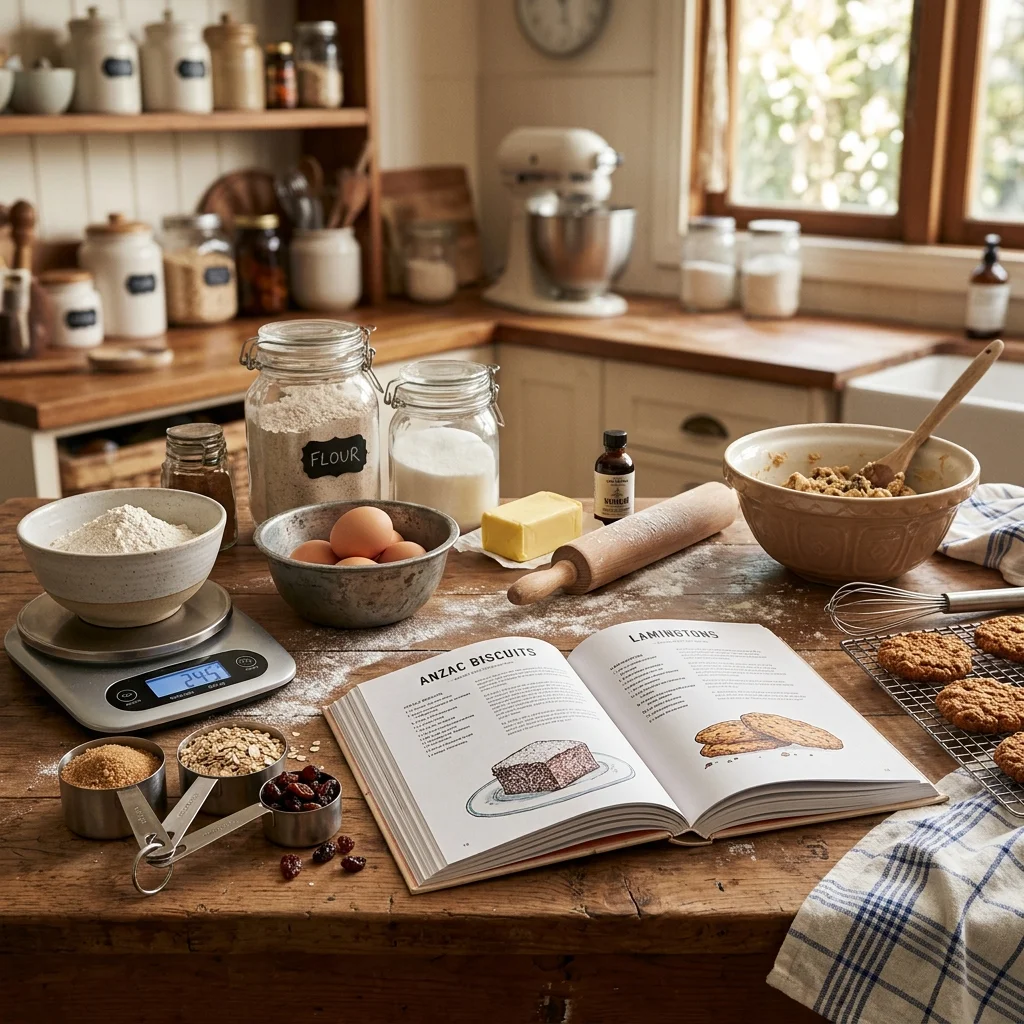
Scaling a baking recipe up or down requires more than simple kitchen arithmetic.
While multiplying or dividing ingredient quantities by a single scaling factor is straightforward, successful recipe scaling depends on three distinct variables: 1) ingredient ratios, 2) baking pan geometry and batter depth, and 3) thermal heat transfer and bake timing. Simply doubling every ingredient and doubling the baking time will result in over-browned edges and a raw, sunken center. By understanding how pan volume, surface area, fractional eggs, and leavening interact, you can scale any cake, cookie, loaf, or bread recipe with complete confidence.
Scale recipes instantly with our interactive Interactive Recipe Scaler, adjust pan volume ratios with the Cake Pan Converter, look up dry base weight in All-Purpose Flour Grams to Cups, and portion dough using the Cookie Scoop Size Calculator.
The Basic Recipe Scaling Formula
To scale any recipe, determine your Scaling Factor (SF) by dividing your desired target yield by the original recipe yield:
- Halving a Recipe (0.5× Batch): Multiply every ingredient by
0.5(or divide by 2). - Doubling a Recipe (2.0× Batch): Multiply every ingredient by
2.0. - Tripling a Recipe (3.0× Batch): Multiply every ingredient by
3.0. - 1.5× Batch (Scaling 8-inch to 9-inch pan): Multiply every ingredient by
1.5.
How to Halve a Recipe
When halving volume-based recipes, standard cup and spoon measurements can produce awkward fractions. Refer to this quick-reference volume conversion chart:
| Original Volume | Half-Batch Exact Calculation | Practical Kitchen Measure |
|---|---|---|
| 1 US Cup | 1/2 US Cup | 1/2 cup (8 tablespoons) |
| 3/4 US Cup | 3/8 US Cup | 6 tablespoons |
| 2/3 US Cup | 1/3 US Cup | 1/3 cup (5 tbsp + 1 tsp) |
| 1/2 US Cup | 1/4 US Cup | 1/4 cup (4 tablespoons) |
| 1/3 US Cup | 1/6 US Cup | 2 tbsp + 2 teaspoons |
| 1/4 US Cup | 1/8 US Cup | 2 tablespoons |
| 1 Tablespoon | 1/2 Tablespoon | 1 1/2 teaspoons |
| 1 Teaspoon | 1/2 Teaspoon | 1/2 teaspoon |
For pan substitution rules when halving cakes or bars, consult our master Baking Pan Conversion Chart.
How to Double a Recipe
When doubling a recipe, multiply every ingredient by 2. However, keep these critical warnings in mind:
- Do NOT Double the Baking Time: Doubling ingredients in two separate cake pans requires almost identical bake time as a single batch.
- Do NOT Change Oven Temperature: Keep your oven set to the original specified temperature (e.g. 350°F / 175°C).
- Watch Bowl and Mixer Capacity: Doubling heavy bread doughs or cake batters can overload 4.5-quart stand mixers or 5-liter bowls.
How to Scale Recipes by Weight
The single most effective way to eliminate fraction confusion when halving or doubling recipes is to bake by weight in grams.
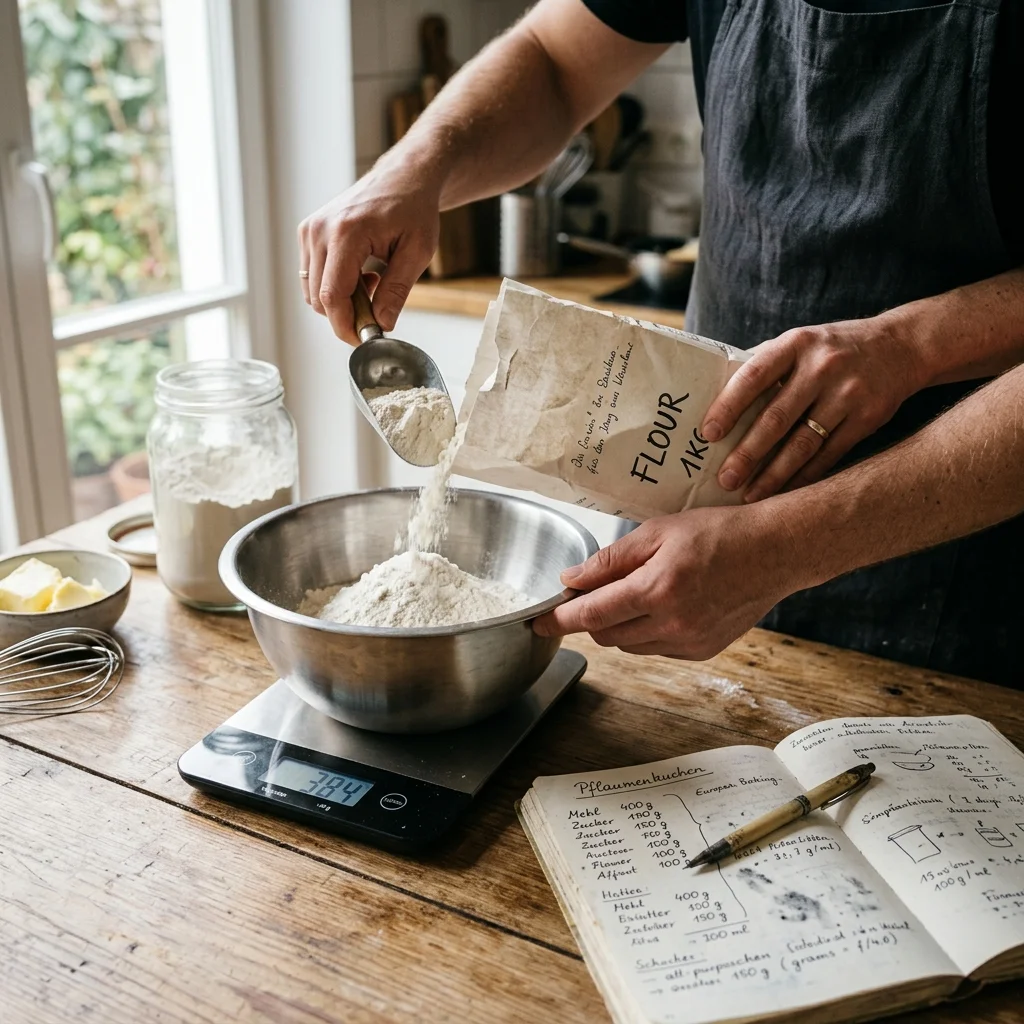
Halving 125 grams of flour requires simple mental division: 125g ÷ 2 = 62.5g. You simply place your mixing bowl on a scale and pour to 62.5 grams. Learn scale operations in our Step-by-Step Guide: How to Use a Digital Kitchen Scale and review benefits in Why Baking by Weight Is Superior to Measuring by Volume.
How to Halve One Egg
Dividing a single egg in half is a classic baking dilemma. According to King Arthur Baking, a standard US Large egg without shell weighs approximately 50 grams (30 grams of egg white and 20 grams of egg yolk).
To halve an egg accurately:
- Crack one large egg into a small ramekin sitting on your digital scale.
- Whisk the egg thoroughly with a fork until the yolk and white form a homogeneous liquid.
- Check total weight (typically 48g to 52g).
- Press Tare, and pour out exactly half the weight (25 grams) into your mixing bowl.
Volume Alternative: 1 large whisked egg equals roughly 3.5 tablespoons. Half an egg is approximately 1 tablespoon plus 2 teaspoons of whisked egg.
How to Scale Multiple Eggs
When scaling recipes with multiple eggs, apply these rules:
- Doubling a 1-Egg Recipe: Use 2 whole eggs.
- Halving a 3-Egg Recipe: You need 1.5 eggs. Use 1 whole egg + 25 grams of a whisked second egg (or 75 grams of total whisked egg).
- Halving a 1-Egg Cake Recipe: If you prefer not to divide an egg, using 1 whole egg in a half-batch cake slightly increases richness and structure, but works well for rustic quick breads and cookies.
Do You Double or Halve Baking Powder and Baking Soda?
For standard household scaling (halving or doubling a batch), scale chemical leaveners linearly with all other ingredients. If a full recipe calls for 1 teaspoon of baking powder, use 1/2 teaspoon for a half-batch and 2 teaspoons for a double batch.
Note on Commercial Quadrupling: When multiplying a recipe by 4× or 8× in commercial bakeries, chemical leaveners are often reduced slightly (by 10–15%) because large batter volumes retain expanding carbon dioxide gas more efficiently.
Do You Change Oven Temperature?
No. Always maintain the original recipe's specified oven temperature.
Oven temperature controls the rate of heat transfer, sugar caramelization, and protein coagulation. Raising oven temperature for a double batch will scorch the outer crust before the interior cooks. Lowering temperature for a half-batch will prevent proper rise and steam expansion.
How to Adjust Baking Time
Baking time is governed by **batter depth** and **surface area**, not total batch weight:
- Doubling into Two Separate Original Pans: Bake time remains virtually identical to the single batch (check doneness 2 to 3 minutes earlier due to oven load).
- Halving into a Smaller Pan with Equal Batter Depth: Bake time is typically reduced by 15% to 25%. Start testing doneness at 60% of the original bake time.
- Halving into a Pan That Is Too Large (Shallower Batter): Shallow batter bakes much faster! Reduce bake time by 30% to 40% to prevent drying out.
Always rely on visual doneness cues: a toothpick inserted in the center comes out clean, cake edges pull away slightly from pan walls, or an instant-read thermometer reads 200°F–205°F for quick breads and cakes.
How Pan Size Changes Recipe Scaling
To maintain identical batter depth when scaling, match your target pan surface area to your scaling factor:
| Original Recipe Pan | Surface Area | Half-Batch (0.5×) Pan Option | Double-Batch (2.0×) Pan Option |
|---|---|---|---|
| 9x13-inch Rectangular | 117 sq in | 8x8-inch Square (64 sq in) or 9x9 Square | Two 9x13-inch pans |
| 8x8-inch Square | 64 sq in | 9x5 Loaf pan or 6 Muffin cups | 9x13-inch Rectangular (117 sq in) |
| 9x9-inch Square | 81 sq in | 8.5x4.5 Loaf pan | Two 9x9 Square pans or 9x13 pan |
| 9-inch Round Cake Pan | 63.6 sq in | 8x4 Loaf pan or 6 Muffin cups | Two 9-inch Round pans |
| 8-inch Round Cake Pan | 50.3 sq in | 6-inch Round pan | Two 8-inch Round pans |
| 12-Cup Muffin Tin | ~36 sq in | 6 Muffin cups | Two 12-Cup Muffin Tins |
Why Pan Surface Area and Volume Matter
Pan geometry is non-linear. Increasing a round pan diameter by just 1 inch significantly increases surface area:
- Round Pan Area Formula:
Area = π × r²(where r is half the diameter). - 8-inch Round Pan: 3.14 × (4)² = 50.3 square inches.
- 9-inch Round Pan: 3.14 × (4.5)² = 63.6 square inches (a 26% increase in surface area!).
If you pour a 9-inch round cake batter into an 8-inch round pan without adjusting, the batter will sit too deep, rise over the edges, and fail to bake through in the center.
How to Scale Cookies and Muffins
Portion-based recipes like cookies and muffins are the easiest to scale because individual portion geometry remains unchanged:
- Cookies: Doubling a recipe yielding 24 cookies yields 48 cookies. Bake time per tray remains identical (350°F for 10–12 minutes). Try our Ultimate Chocolate Chip Cookie Recipe by Weight (Grams).
- Muffins: Halving a 12-muffin recipe yields 6 muffins. Bake in 6 wells of a standard muffin tin at the original temperature and time.
How to Scale Bread Recipes
Artisan yeast bread formulas scale effortlessly using baker's percentages (where total flour weight = 100%). To scale a bread recipe from 500g flour to 750g flour, multiply every ingredient by 1.5. Read Artisan Bread Baking: Understanding Baker's Percentages and Gram Weights.
How to Scale Sourdough
Sourdough starters contain live wild yeast and lactobacilli. When halving or doubling sourdough, scale flour, water, starter, and salt proportionally. For deep hydration calculations, explore Sourdough Starter & Bread Hydration.
When NOT to Scale a Recipe
Avoid scaling recipes under these delicate conditions:
- Delicate Soufflés & Merringues: Whipped egg foam stability depends on exact bowl depth and aeration dynamics.
- Sugar Candy & Caramel: Boiling sugar syrups react differently to pot surface area and evaporation rates.
- Deep Specialty Bundt Pans: Filling a 12-cup Bundt pan halfway distorts heat circulation.
Common Scaling Mistakes
Avoid these four frequent recipe scaling traps:
- Changing Ingredients Without Changing Pan Size: Pouring half a cake batter into a full-sized 9x13 pan results in a dry, thin pancake.
- Assuming Bake Time Scales Linearly: Doubling a recipe does NOT mean doubling bake time from 30 minutes to 60 minutes!
- Guessing Egg Fractions: Adding a full egg when halving a delicate recipe changes liquid-to-flour balance. Whisk and weigh 25 grams instead.
- Measuring Volume Cups Instead of Weight: Review How to Measure Flour Correctly, Top 7 Gram-to-Cup Conversion Mistakes Bakers Make (And How to Fix Them), and The Master Cups to Grams Baking Conversion Guide.
Practical Scaling Examples
Example 1: Halving Chocolate Chip Cookies
Original: 240g flour, 113g butter, 100g sugar, 1 egg.
Half-Batch: 120g flour, 56.5g butter, 50g sugar, 25g whisked egg. Bake at 350°F for 10–12 min.
Example 2: Doubling Banana Bread
Original: 250g AP flour, 450g mashed banana, 2 eggs.
Double-Batch: 500g AP flour, 900g mashed banana, 4 eggs. Divide batter equally into two 9x5 loaf pans and bake at 350°F for 55–60 min. Try our Moist Metric Banana Bread Recipe (Gram Measurements).
Example 3: Halving a 9x13 Cake into an 8x8 Pan
Original 9x13 area = 117 sq in. Half area = 58.5 sq in. An 8x8-inch square pan (64 sq in) provides an almost perfect match! Bake at original temperature, testing doneness 5 minutes earlier.
Frequently Asked Questions
1. Can I simply halve every ingredient in a recipe?
Yes, for ingredients. However, you must also adjust your pan size to maintain proper batter depth and monitor baking time visual cues.
2. How do I double a baking recipe?
Multiply all ingredient weights by 2. Bake in two separate original pans or a pan with double the surface area at the original oven temperature.
3. How do I halve one egg for a recipe?
Crack a large egg (~50g without shell) into a dish, whisk thoroughly, and weigh out 25 grams on a digital scale (or use 1 tbsp + 2 tsp).
4. Does baking time change when you halve a recipe?
Yes. A half-batch in a smaller pan usually bakes 15% to 25% faster. Start checking doneness earlier using toothpick tests.
5. Does baking temperature change when doubling a recipe?
No. Keep the oven temperature identical to ensure proper protein setting and crust caramelization without scorching.
6. What pan should I use for half a 9x13 recipe?
An 8x8-inch square pan (64 sq in) or 9x9-inch square pan (81 sq in) provides the ideal surface area for half a 9x13 recipe (117 sq in).
7. How do I scale a recipe using grams?
Multiply or divide gram weights directly by your scaling factor (e.g. 250g flour × 0.5 = 125g), eliminating volume fraction math.
8. Can I scale bread recipes easily?
Yes. Bread recipes scale seamlessly using baker's percentages, where all ingredients are calculated relative to 100% flour weight.
9. Can I scale sourdough recipes?
Yes. Scale flour, water, starter, and salt proportionally. Fermentation times remain constant if starter percentage and room temperature match.
10. How do I scale a recipe from 4 servings to 6?
Calculate your scaling factor: 6 ÷ 4 = 1.5. Multiply all ingredient weights by 1.5 and select a slightly larger baking pan.
11. How do I know if my scaled cake pan is too full?
Raw cake batter should fill a pan no more than 1/2 to 2/3 full to allow proper rising room without spilling over.
12. Why doesn't baking time double when I double a recipe?
Bake time depends on heat penetration depth, not total weight. If batter depth remains constant across two pans, heat cooks the batter in the same time.
When doubling or halving batter recipes like our fluffy American pancakes recipe by weight, make sure to adjust fat ratios using our butter sticks to grams conversion chart.
When working with vintage family heirloom recipes, consult our guide to converting grandma's recipes into modern gram weights before adjusting batch sizes.
Interactive Recipe Scaler
Scale ingredient batch sizes by multiplying or dividing servings.
Interactive Baking Calculator Widget
Adjust inputs below for instant real-time recipe formulation.
Need Full Density Reference Tables?
Explore complete g/cup density tables, USDA ratios, and measurement tools.
Related Baking Guides
Top 5 Best Kitchen Digital Scales for Baking Precision in 2026
Compare the best kitchen scales for baking, including accuracy, capacity, tare functions, readability, and features that matter for precise recipes.
Kitchen ToolsLiquid Measuring Cups vs Dry Measuring Cups: Are They Interchangeable?
Learn the difference between dry and liquid measuring cups, how each works, when to use them, and how to measure flour, sugar, milk, oil, and more accurately.
Kitchen ToolsStep-by-Step Guide: How to Use a Digital Kitchen Scale for Baking
Learn how to use a digital kitchen scale for baking, including tare, grams, ounces, weighing flour, liquids, multiple ingredients, and recipe conversions.