How to Bake European Recipes in an American Kitchen
"Learn how to convert European baking recipes for an American kitchen, including grams, milliliters, Celsius, gas marks, cups, and ingredient weights."
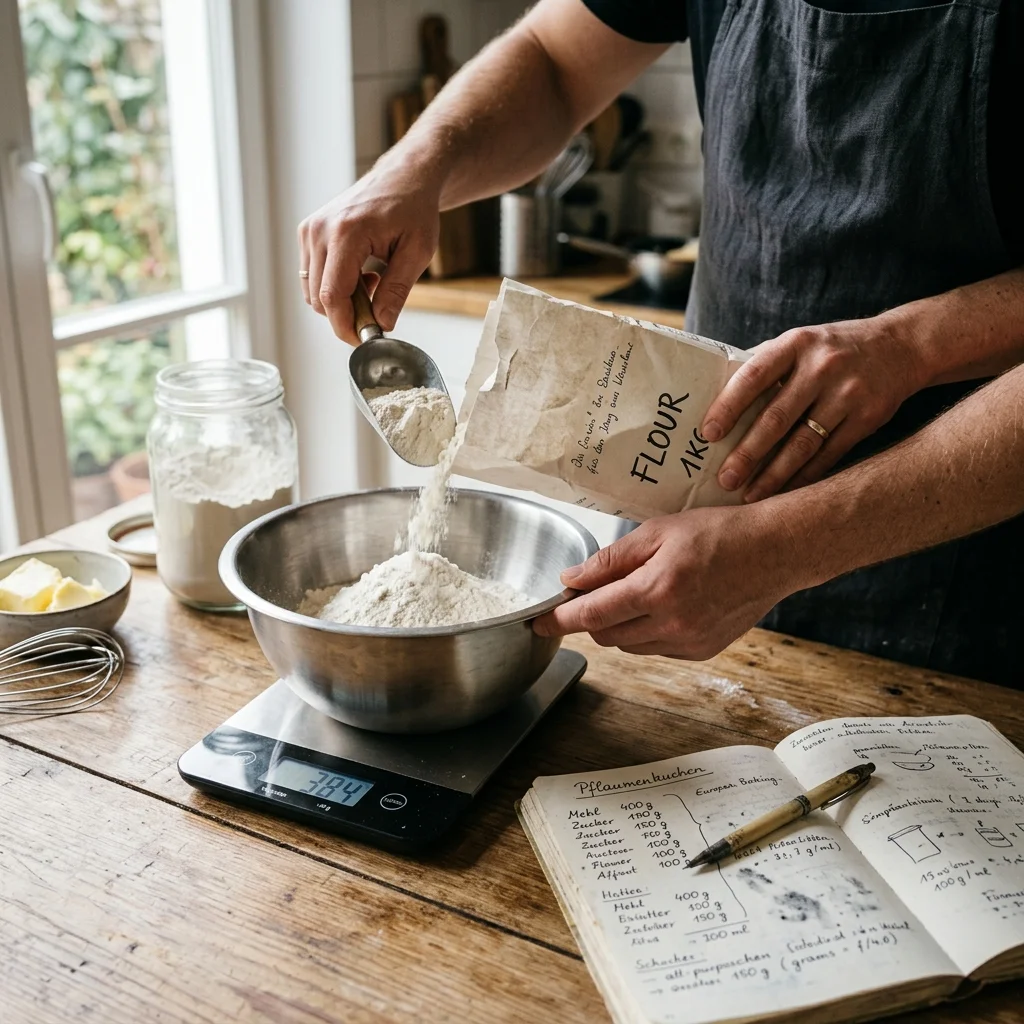
Baking a French tart au citron, a German Schwarzwälder Kirschtorte, or a British Victoria sponge in an American kitchen requires converting three key culinary variables: mass measurements in grams, liquid volumes in milliliters, and oven temperatures in Celsius.
The single most effective strategy when baking European recipes in the United States is to keep weight measurements in grams using an inexpensive digital kitchen scale rather than converting dry ingredients into American volume cups. Because bulk density varies between French flour types, German sugars, and American pantry staples, converting metric weight into cups introduces volume errors up to 25%. However, when cup conversion is necessary, understanding regional European conventions, fluid volume differences, oven heat modes, and ingredient naming equivalents ensures your European bakes turn out with perfect texture and balance.
Convert liquid fluid weights with our Density Database, convert butter sticks via the Butter Stick Converter, and explore our Dairy Conversions Hub.
European vs American Baking Measurements at a Glance
The reference matrix below compares standard measurement units across European metric recipes and their American kitchen equivalents:
| Measurement Unit | European / Metric Standard | US Kitchen Equivalent | Best Conversion Method |
|---|---|---|---|
| Dry Mass (Flour, Sugar) | Grams (g) / Kilograms (kg) | US Customary Cups / Ounces (oz) | Weigh on digital scale in grams (No cup conversion) |
| Liquid Volume (Milk, Water) | Milliliters (mL) / Liters (L) | US Fluid Ounces / US Liquid Cups | 1 US Cup = 236.6 mL (or 240 mL metric liquid jug) |
| Butter & Solid Fats | Grams (g) | Sticks / US Cups / Ounces | 1 US Stick = 113.4g (1/2 cup = 4 oz) |
| Oven Temperature | Degrees Celsius (°C) | Degrees Fahrenheit (°F) | Formula: °F = (°C * 9/5) + 32 |
| British Oven Setting | UK Gas Marks (Gas 1 to 9) | Fahrenheit (°F) Dial Setting | Gas Mark 4 = 350°F (180°C) |
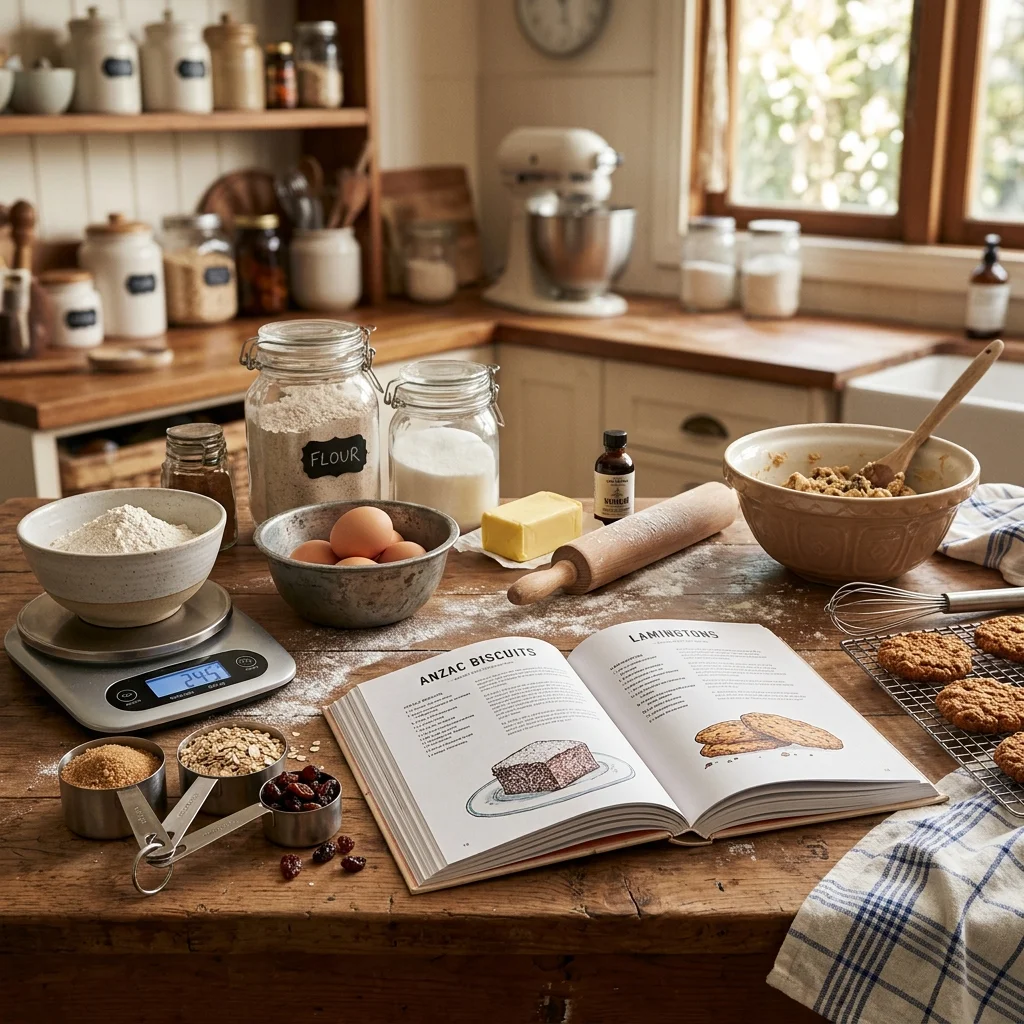
Why European Baking Recipes Often Use Grams
In continental Europe (France, Germany, Italy, Spain) and the UK, recipe developers almost exclusively formulate baking recipes in grams because gram weights measure absolute physical mass regardless of bulk density. When a French pastry chef specifies 250g of flour, that mass remains identical whether using fine French T45 pastry flour or American all-purpose flour.
Conversely, American volume cups measure three-dimensional space, which varies depending on flour sifting, packing density, and humidity. To learn why test kitchens advocate weighing dry ingredients, read our in-depth guide: Why Baking by Weight Is Superior to Measuring by Volume.
How to Convert Grams to US Baking Measurements
If you do not own a digital kitchen scale and must convert European grams to US volume cups, you must perform ingredient-specific conversions. Never use a single universal factor (such as dividing all grams by 200) across different dry ingredients.
Consider the density variations among common baking ingredients:
- All-Purpose Flour: 1 US Cup = 125 grams (Formula:
Cups = Grams / 125). E.g., 250g flour = 2 cups. (Learn techniques in How to Measure Flour Correctly). - Granulated Sugar: 1 US Cup = 200 grams (Formula:
Cups = Grams / 200). E.g., 200g sugar = 1 cup. (Reference our Sugar Conversion Guide). - Butter: 1 US Cup = 227 grams (1 US Stick = 113.4g). E.g., 250g butter = 2.2 sticks (approx 1 cup + 1.5 tbsp). (See Butter Conversion Master Table).
- Unsweetened Cocoa Powder: 1 US Cup = 85 grams. E.g., 100g cocoa = approx 1.15 cups (1 cup + 2.5 tbsp).
For complete conversion charts covering 50+ baking ingredients, consult The Master Cups to Grams Baking Conversion Guide.
How to Convert Milliliters to Cups
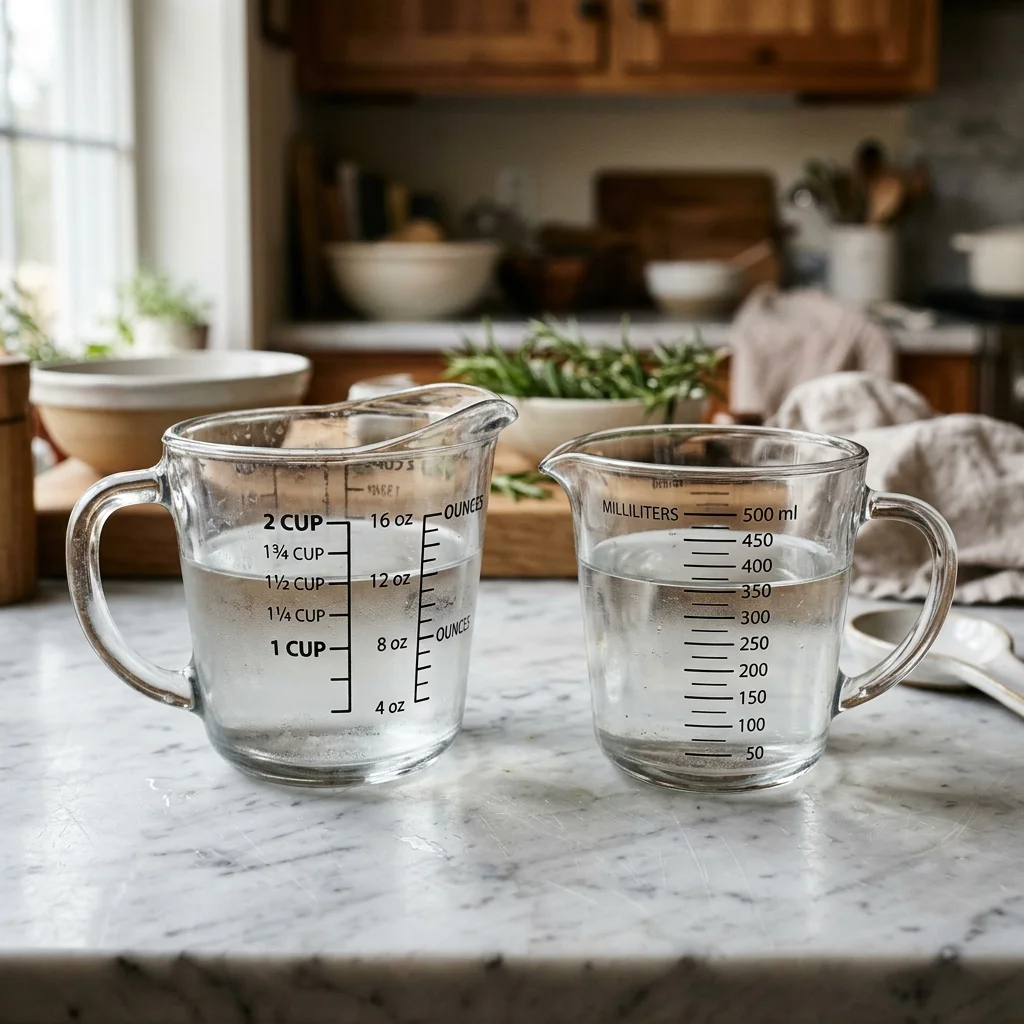
Liquid volume units (milliliters and liters) measure pure liquid volume. In US kitchens, liquid measuring cups use the standard ratio of 1 US Customary Cup = 236.6 mL (often rounded to 240 mL in modern commercial cookware).
| Metric Volume (mL) | Exact US Liquid Cups | Practical US Cup & Spoon Approximation | Fluid Ounces (fl oz) |
|---|---|---|---|
| 50 mL | 0.21 Cups | 3 Tablespoons + 1 Teaspoon | 1.69 fl oz |
| 100 mL | 0.42 Cups | 6 Tablespoons + 2 Teaspoons (approx 7/16 cup) | 3.38 fl oz |
| 125 mL | 0.53 Cups | 1/2 Cup + 1 Teaspoon | 4.23 fl oz |
| 200 mL | 0.85 Cups | 3/4 Cup + 1 Tablespoon | 6.76 fl oz |
| 250 mL | 1.06 Cups | 1 US Cup + 1 Tablespoon (Exact 1 Metric Cup) | 8.45 fl oz |
| 500 mL | 2.11 Cups | 2 US Cups + 2 Tablespoons | 16.91 fl oz |
| 1 Liter (1,000 mL) | 4.23 Cups | 4 US Cups + 3.5 Tablespoons (1 Quart + 3 tbsp) | 33.81 fl oz |
Note that in Australia, New Zealand, and parts of the UK, a Metric Cup is standardized to exactly 250 mL, which is 5.6% larger than an American 236.6 mL cup. Read our breakdown in US Cup vs Metric Cup vs Imperial Cup: The International Baking Guide.
Celsius to Fahrenheit Oven Temperature Conversion
European recipes state baking temperatures in degrees Celsius (°C). American home ovens use degrees Fahrenheit (°F). To convert Celsius to Fahrenheit, use the exact mathematical formula: °F = (°C * 9/5) + 32.
| European Recipe Temp (°C) | Exact Formula Output (°F) | Standard US Oven Dial Setting (°F) | Baking Application |
|---|---|---|---|
| 160°C | 320°F | 325°F (Low & Slow) | Meringues, cheesecakes, delicate sponges |
| 170°C | 338°F | 340°F – 350°F | Swiss rolls, fruit tarts, cookies |
| 175°C | 347°F | 350°F (Gold Standard) | Standard cakes, muffins, quick breads |
| 180°C | 356°F | 350°F – 365°F | German bundt cakes, French choux pastry |
| 190°C | 374°F | 375°F | Puff pastry, tart shells, scones |
| 200°C | 392°F | 400°F | Crusty artisan bread, rolls, pies |
| 220°C | 428°F | 425°F – 430°F | High-heat sourdough dutch oven baking |
Convection Fan Warning (Umluft / Fan-Forced): European recipes that specify fan-forced or convection baking (German Umluft) cook faster due to active airflow. When using an American conventional non-convection oven, increase the target temperature by 20°C (approx 35°F) or extend baking time by 10%.
UK Gas Marks Explained
British vintage cookbooks and UK recipes frequently reference Gas Marks rather than numerical temperatures. Gas Mark settings correspond to specific Celsius and Fahrenheit oven temperatures:
| UK Gas Mark | Equivalent Celsius (°C) | Equivalent Fahrenheit (°F) | Heat Description |
|---|---|---|---|
| Gas Mark 1/2 | 120°C | 250°F | Very Cool / Slow |
| Gas Mark 1 | 140°C | 275°F | Cool |
| Gas Mark 2 | 150°C | 300°F | Slow |
| Gas Mark 3 | 160°C | 325°F | Warm |
| Gas Mark 4 | 180°C | 350°F | Moderate (Standard Baking) |
| Gas Mark 5 | 190°C | 375°F | Fairly Hot |
| Gas Mark 6 | 200°C | 400°F | Hot |
| Gas Mark 7 | 220°C | 425°F | Very Hot |
| Gas Mark 8 | 230°C | 450°F | Extremely Hot |
French Baking Terms American Bakers Should Know
When baking authentic French pâtisserie, understanding key French ingredient terminology prevents costly recipe errors:
- Farine (Flour): Classified by ash content type numbers. Farine T45 (pastry flour, ~9% protein), Farine T55 (standard all-purpose flour, ~10.5% protein), and Farine T65 (bread flour, ~12% protein).
- Sucre (Sugar): Sucre en poudre (granulated white sugar), Sucre glace (powdered confectioners' sugar), and Sucre cassonade (unrefined brown cane sugar).
- Beurre (Butter): Beurre doux (unsalted European butter with 82% butterfat), Beurre demi-sel (lightly salted butter), and Beurre noisette (browned nut butter).
- Levure (Leavening): Levure chimique or Levure Alsacienne (baking powder packets, usually 11g per sachet) and Levure de boulanger (baker's active dry or fresh yeast). (See Baking Powder vs Baking Soda).
- Crème (Cream): Crème fraîche (heavy cultured cream with 30–45% fat) and Crème liquide / Fleurette (heavy liquid whipping cream).
German Baking Terms American Bakers Should Know
German baking (Backen) uses structured standardized packaging and oven heat definitions:
- Mehl (Flour): Type 405 (fine cake/pastry flour), Type 550 (all-purpose flour equivalent), and Type 1050 (whole wheat / high-ash bread flour).
- Backpulver & Vanillezucker: German recipes list leavening and flavorings in single-use paper packets (1 Päckchen Backpulver = approx 15g or 1 tbsp baking powder; 1 Päckchen Vanillezucker = 8g vanilla-infused sugar).
- Hefe (Yeast): Frische Hefe (fresh compressed cake yeast, usually sold in 42g cubes) and Trockenhefe (dry active yeast packets, 7g each).
- Oven Heat Settings: Ober-/Unterhitze (conventional top and bottom heating) vs Umluft (convection fan mode).
European Ingredient Names That Can Confuse US Bakers
British and European ingredient names differ significantly from US grocery store labels. Here is how to substitute them in an American kitchen:
| European / UK Term | US Grocery Store Equivalent | Substitution Notes & Ratios |
|---|---|---|
| Caster Sugar | Superfine Sugar | Pulse granulated sugar in food processor for 10 seconds. |
| Icing Sugar | Powdered / Confectioners' Sugar | Contains cornstarch to prevent clumping. 1:1 substitute. |
| Plain Flour | All-Purpose Flour | US AP flour has slightly higher protein (~10.5-11.5%). 1:1 substitute. |
| Self-Raising Flour | Self-Rising Flour | Or per cup AP flour add 1.5 tsp baking powder + 1/4 tsp salt. |
| Double Cream (48% fat) | Heavy Whipping Cream (36% fat) | US heavy cream has less butterfat; add 1 tbsp melted butter if needed. |
| Bicarbonate of Soda | Baking Soda | 100% pure sodium bicarbonate. Exact 1:1 substitute. |
A Step-by-Step Method for Converting Any European Recipe
Follow this 7-step method whenever converting a European recipe in an American kitchen:
- Identify the country of origin: Check whether the recipe originates from France, Germany, or the UK to determine volume standards and ingredient terminology.
- Keep dry mass in grams: Set your digital kitchen scale to grams (
g) and weigh flour, sugar, butter, and chocolate directly into your mixing bowl. - Convert liquid volumes: Measure milk, water, and cream using a glass measuring jug graduated in milliliters (or convert using 236.6 mL per US cup).
- Convert oven temperature: Use the formula
°F = (°C * 9/5) + 32or consult our oven conversion table. Adjust for convection fan settings if applicable. - Check butter fat content: European butter contains 82% butterfat versus US butter at 80%. For laminated pastries or brioche, use high-fat European-style US butter (like Plugra or Kerrygold).
- Substitute regional leavening: Convert European baking powder sachets (11g–15g) to US teaspoons (1 sachet = approx 2.5 to 3 teaspoons).
- Scale recipe after conversion: Never scale cup measurements before converting to grams. Perform all multiplier math in metric weight first.
Explore international recipe conversion strategies in Converting Metric Baking Recipes (UK, European, Australian) for US Cooks.
Example European Recipe Conversion: French Yogurt Cake (Gâteau au Yaourt)
Below is a practical conversion example demonstrating how a traditional French recipe translates into an American kitchen setup:
Original French Recipe vs US Kitchen Execution
Original Metric Recipe (France):
- 125g yaourt nature (plain yogurt)
- 150g sucre en poudre
- 250g farine T55
- 75 mL huile végétale
- 1 sachet de levure chimique (11g)
- Bake at 180°C (conventional oven)
US Kitchen Preparation:
- Weigh 125g whole milk plain yogurt on digital scale
- Weigh 150g granulated sugar (approx 3/4 US cup)
- Weigh 250g all-purpose flour (approx 2 US cups)
- Measure 75 mL vegetable oil (approx 1/3 US cup)
- Use 2.25 tsp double-acting US baking powder
- Preheat US oven to 350°F (180°C)
Common Conversion Mistakes to Avoid
Watch out for these six common pitfalls when baking European recipes in the US:
- Assuming All Cups Are US Cups: Confusing a 250 mL metric cup (Australia/UK) with a 236.6 mL US cup introduces a 5.6% volume error. (Read Top 7 Gram-to-Cup Conversion Mistakes).
- Converting Flour Using Sugar Factors: Dividing flour grams by 200 (the factor for sugar) yields 1.25 cups instead of the correct 2 cups for 250g flour.
- Confusing Grams (Weight) and Milliliters (Volume): While 1 mL of pure water weighs exactly 1 gram, 100 mL of honey weighs 142 grams and 100 mL of oil weighs 92 grams!
- Ignoring Convection Fan Offset: Baking a French recipe set for 180°C in an American conventional oven without convection fan airflow can leave the center undercooked.
- Using Cold High-Fat European Butter: European butter has less water than US butter. Ensure European butter is properly softened to creaming temperature (65°F–68°F).
- Converting Small Leavening Amounts to Cups: Always measure yeast, baking powder, and salt in exact grams or teaspoons rather than converting to fraction cups.
Frequently Asked Questions
1. How do I convert a European recipe to American measurements?
The easiest method is to use a digital kitchen scale set to grams for dry ingredients, a liquid measuring jug for milliliters, and convert oven temperatures from Celsius to Fahrenheit using °F = (°C * 9/5) + 32.
2. Do European recipes always use grams?
Yes. Professional and home baking recipes in continental Europe and the UK almost universally list dry ingredients in grams rather than volume cups to ensure exact baking ratios.
3. What is 180°C in Fahrenheit for baking?
180°C equals 356°F. In American home kitchens, set your oven dial to 350°F or 360°F for standard baking.
4. How many cups is 250 mL?
250 mL equals 1.06 US Customary Cups (approx 1 cup plus 1 tablespoon). In metric cup countries (Australia, UK), 250 mL equals exactly 1 metric cup.
5. Are European cups the same as US cups?
No. European metric cups hold 250 mL, whereas US customary cups hold 236.6 mL. Vintage UK Imperial cups hold 284 mL.
6. What is 200 grams of flour in cups?
200 grams of all-purpose flour equals 1.6 US cups (approx 1 1/2 cups plus 1 1/2 tablespoons).
7. What is plain flour in the US?
Plain flour in British and European recipes is equivalent to American All-Purpose Flour (unbleached all-purpose flour works best).
8. What is caster sugar in America?
Caster sugar is finely ground white sugar. In the US, purchase Superfine Sugar or pulse regular granulated sugar in a food processor for 10 seconds.
9. What is icing sugar in the US?
Icing sugar is the UK and European term for US Powdered Sugar (also called Confectioners' Sugar).
10. How do I convert a UK gas mark to Fahrenheit?
UK Gas Mark 4 equals 350°F (180°C). Each Gas Mark step increases or decreases temperature by roughly 25°F (14°C).
11. Should I convert grams to cups or keep grams?
You should keep grams whenever possible. Using a digital kitchen scale set to grams avoids density conversion errors and guarantees authentic European recipe results.
12. How do I convert milliliters to US cups?
Divide the volume in milliliters by 236.6 (or round to 240 for quick estimation). E.g., 500 mL / 236.6 = 2.11 US cups.
Interactive Baking Weight Converter
Convert recipe volumes into exact gram weights instantly.
Interactive Baking Weight Converter
Convert recipe volumes into exact gram weights instantly.
Custom package weights override standard database densities for this session without altering official database records.
Need Full Density Reference Tables?
Explore complete g/cup density tables, USDA ratios, and measurement tools.
Related Baking Guides
US Cup vs Metric Cup vs Imperial Cup: The International Baking Guide
Learn the difference between US, metric, and Imperial cups, their milliliter sizes, and how to convert international baking recipes accurately.
Baking ScienceWhy Baking by Weight Is Superior to Measuring by Volume
Learn why weighing baking ingredients in grams is more accurate than cups, how density affects volume, and how a kitchen scale improves consistency.
Baking ScienceHigh Altitude Baking Adjustments: Flour, Liquid, and Oven Temps
Learn how to adjust flour, liquid, sugar, leavening, oven temperature, and bake time when baking at high altitude, with practical elevation tips.