How to Measure Flour Correctly: Spoon and Level Method vs Scooping
"Learn how to measure flour correctly using a scale or spoon-and-level method, why scooping adds too much flour, and how accurate measurements improve baking."
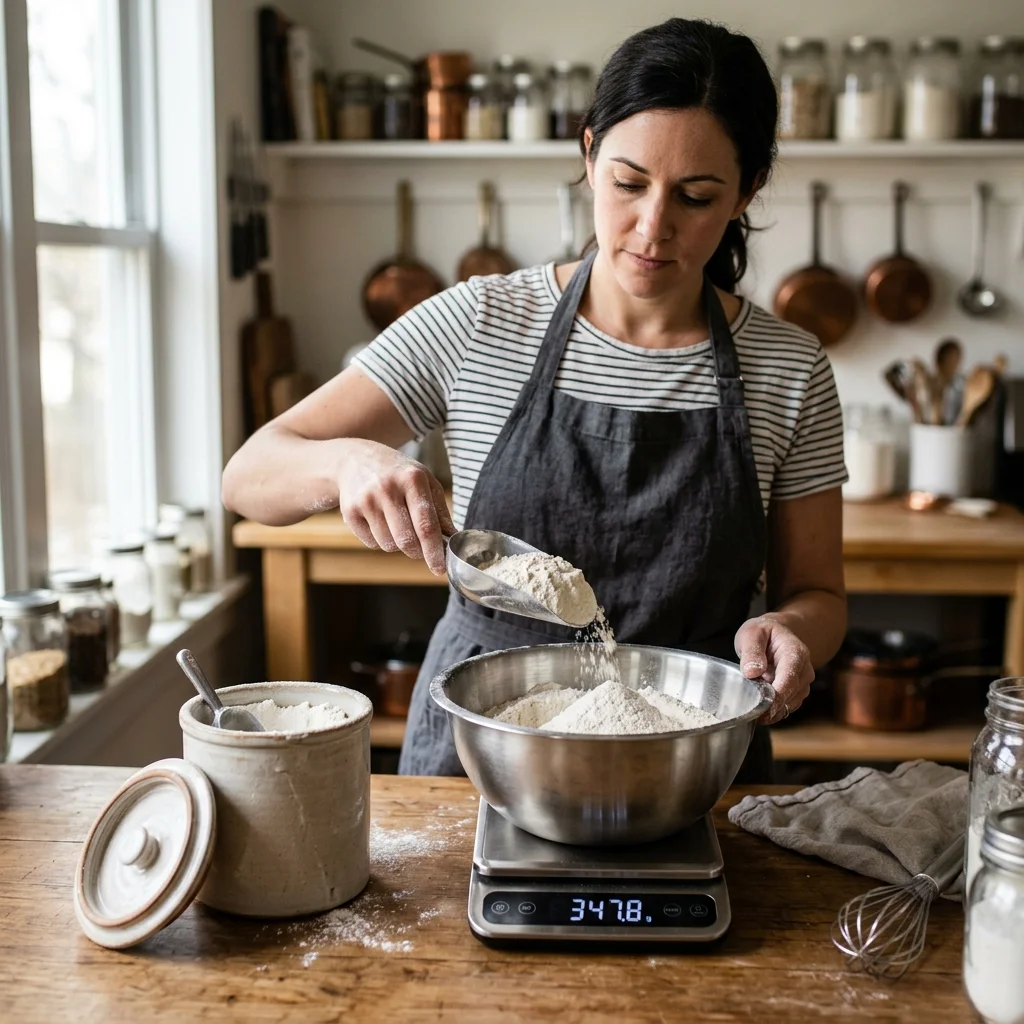
Learning how to measure flour correctly is the single most effective skill you can master to prevent dry cakes, tough cookies, and dense bread. If your baked goods routinely turn out heavier or drier than expected, the culprit is almost certainly packed flour caused by scooping directly from the bag.
Wheat flour is compressible. During shipping, handling, and storage, aerated flour particles settle under gravity, creating a dense, packed powder. When you plunge a dry measuring cup into a bag of flour, you pack down those particles under force. A single scooped cup of all-purpose flour can weigh anywhere from 140 grams to over 160 grams, up to 30% more than standard baking recipes intend. Because most American baking recipes are written assuming a light, aerated cup weighing 120 to 125 grams, scooping accidentally adds extra flour to your batter, upsetting the critical liquid-to-dry ratio required for proper gluten development and moisture retention.
Explore our comprehensive Flour Conversions Silo Hub, calculate small spoon amounts with the Grams to Tablespoons Calculator, or resize formulas with the Interactive Recipe Scaler.
The Most Accurate Way to Measure Flour
The undisputed golden standard for Why Baking by Weight Is Superior to Measuring by Volume is measuring flour by weight in grams using a digital kitchen scale. Unlike volume measurement, mass does not change when flour settles, compacts, or absorbs ambient atmospheric humidity.
When you weigh flour, 125 grams of all-purpose flour remains exactly 125 grams whether it was freshly sifted, packed in a deep storage canister, or fluffed with a fork. Weighing eliminates human variation, eliminates kitchen clean-up by reducing dirty measuring tools, and guarantees total repeatability every single time you bake.
How to Measure Flour With a Kitchen Scale
Weighing flour on a scale takes less than ten seconds once you understand the basic workflow. Follow this simple 5-step process for exact weight accuracy:
- Place your mixing bowl on the scale: Set your dry mixing bowl or measuring container directly onto the flat platform of your digital kitchen scale while turned off or on.
- Tare the scale to zero: Press the Tare or Zero button. The digital screen will display
0 g, subtracting the weight of the bowl so only the added flour is measured. - Add flour gently: Use a large spoon or scoop to transfer flour directly from your container into the bowl.
- Stop at the target gram weight: Watch the digital readout increase and stop precisely when you reach the recipe's required gram weight (for example, 125g for 1 cup of standard all-purpose flour).
- Avoid unnecessary adjust-and-remove steps: If you accidentally pour 2 to 3 grams over your target, there is no need to repeatedly remove tiny pinches of flour. A variance under 2% will not affect domestic baking outcomes.
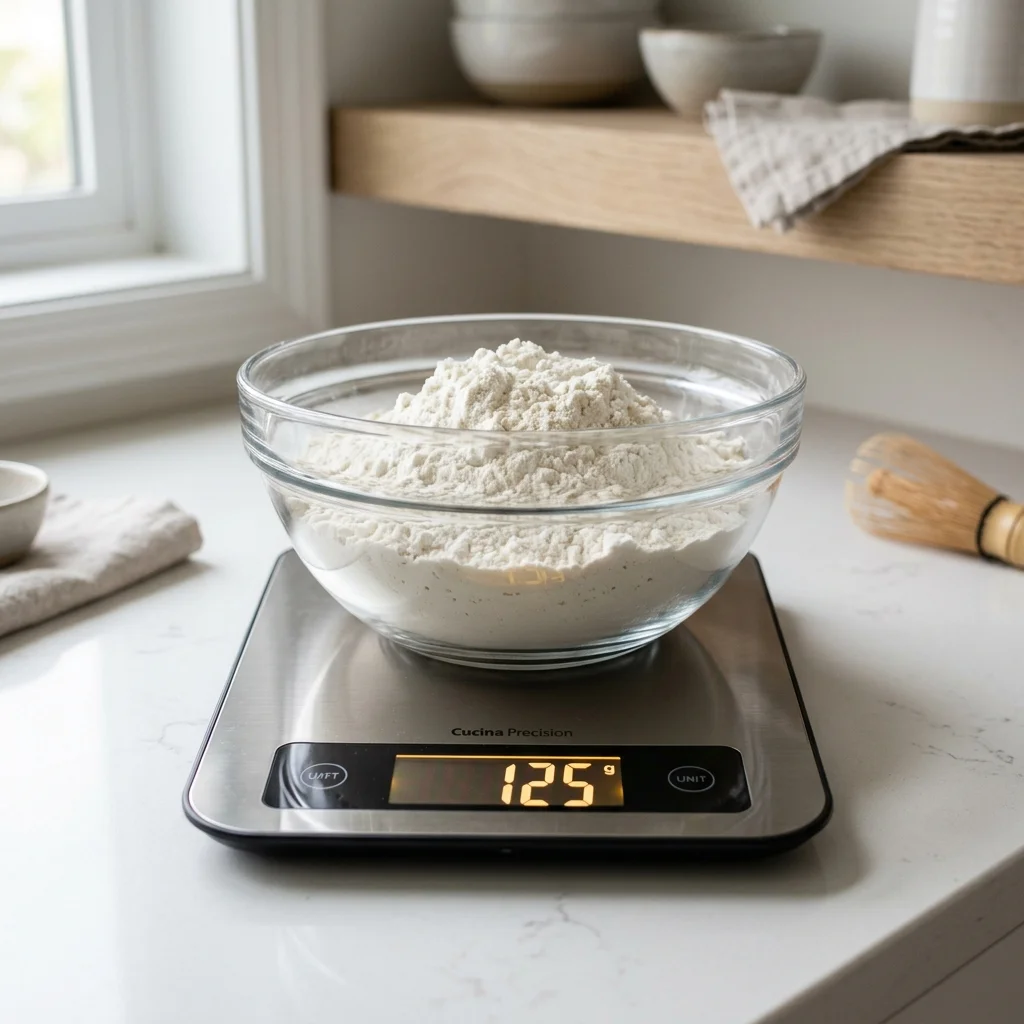
For more detailed tips on setting up and maintaining digital scales, consult our comprehensive Step-by-Step Guide: How to Use a Digital Kitchen Scale for Baking.
How to Measure Flour With the Spoon-and-Level Method
If you do not own a digital kitchen scale, the spoon and level method is the most reliable volume-based technique to prevent over-packing flour. This method mimics the bulk density standard used by professional recipe developers.
Step-by-Step Spoon and Level Instructions
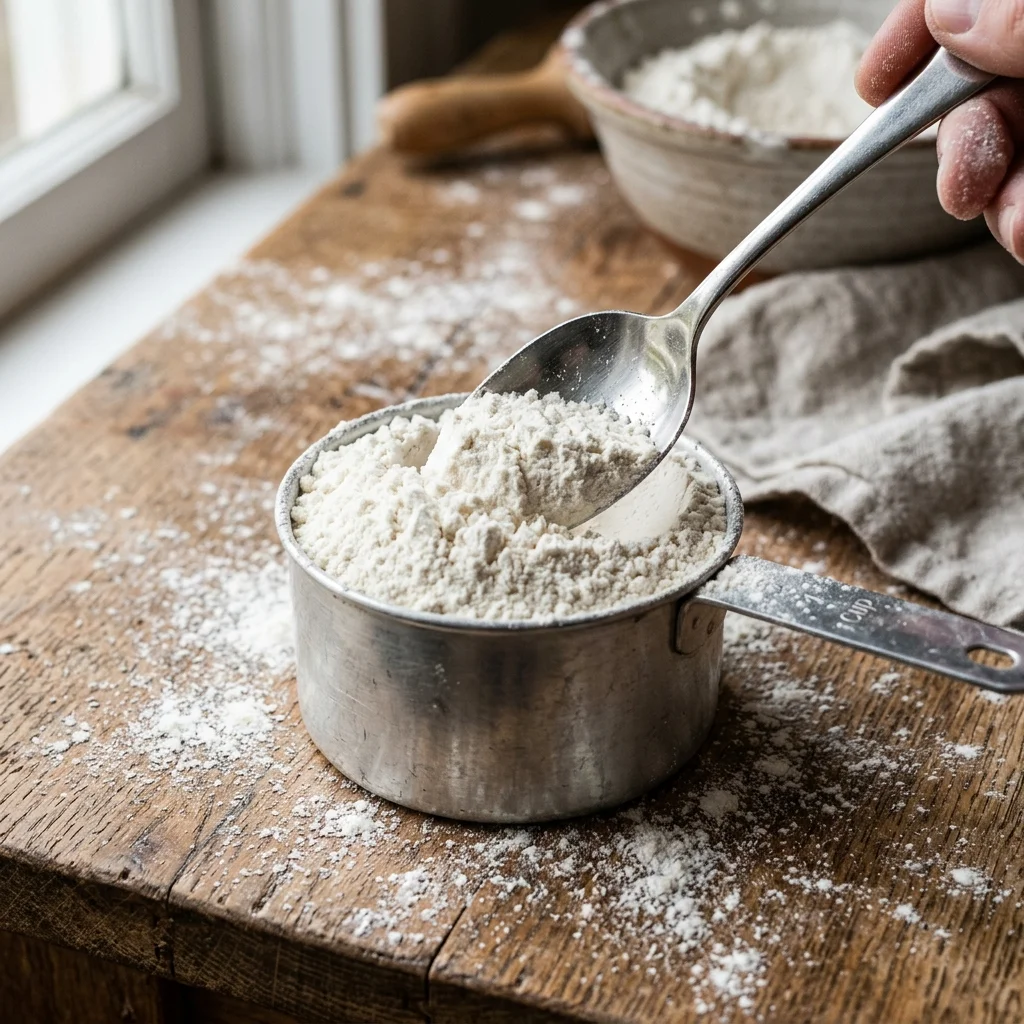
- Fluff the flour: Before scooping, take a spoon, fork, or wire whisk and gently fluff up the flour inside your storage container or bag. This aerates compacted flour particles and incorporates air.
- Spoon into a dry measuring cup: Use a spoon to gently lift aerated flour into your dry metal or plastic measuring cup. Do not use a liquid measuring cup. Allow the flour to mound naturally above the rim.
- Do not tap or shake: Never tap the measuring cup against the counter or shake it side-to-side to settle the top. Tapping causes aerated flour to collapse immediately into a dense layer.
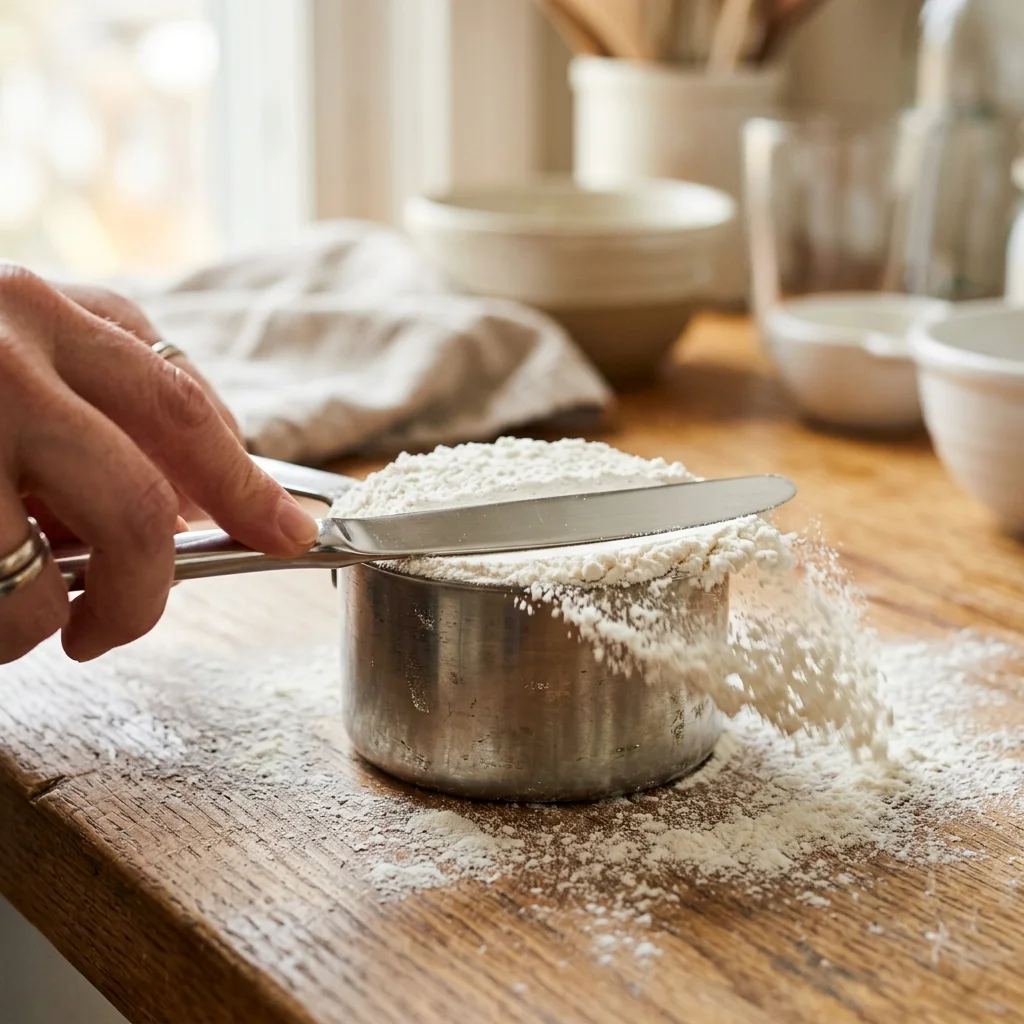
- Level with a straight edge: Hold a straight-edged utensil, such as the flat back of a butter knife or a bench scraper, sweeping it flat across the top rim of the cup to scrape away excess flour.
Spoon and Level vs Scooping Directly From the Bag
To understand why scooping causes recipe failure, it helps to compare what happens physically to flour particles under each technique.
| Measuring Method | Physical Action Taken | State of Flour Particles | Average Weight (1 Cup AP) | Accuracy & Consistency |
|---|---|---|---|---|
| Digital Kitchen Scale | Weigh flour directly in bowl in grams | Independent of density or packing | 125g (or recipe target) | 100% Precise (Gold Standard) |
| Spoon and Level Method | Fluff flour, spoon into cup, sweep flat | Aerated and lightly distributed | 120g – 125g | High (~95% Repeatable) |
| Scooping Directly from Bag | Plunge measuring cup straight into bag | Compressed and packed down | 140g – 160g+ | Poor (Adds 15%–30% extra flour) |
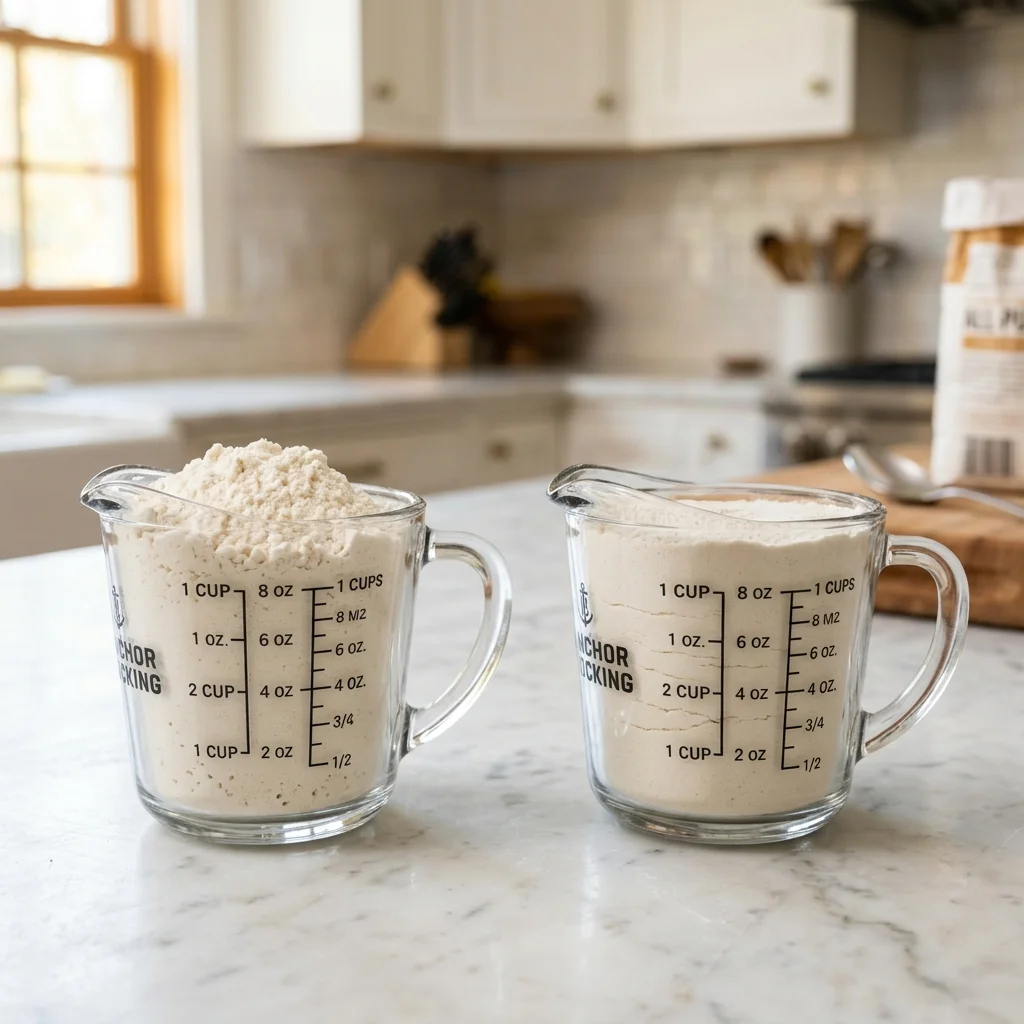
Why Scooping Flour Can Ruin a Recipe
Baking is precise chemistry. Unlike cooking savory stews where extra ingredients can be balanced intuitively, baking relies on exact ratios between gluten-forming proteins, fats, liquids, and sugar. Adding 20 to 35 extra grams of flour per cup fundamentally alters the hydration and structural balance of your bake.
- Cake Texture: Cakes made with scooped flour turn out heavy, rubbery, or crumbly. Excess flour absorbs moisture intended for sugar dissolution and fat distribution, producing a dry crumb.
- Cookies: Extra flour creates stiff cookie dough that fails to spread properly in the oven. Instead of thin, chewy cookies with crisp edges, you end up with thick, pale, cakey mounds.
- Bread Dough: In bread making, extra flour lowers dough hydration percentage. Dough becomes stiff, difficult to knead, slow to rise, and yields a dense, gummy loaf crumb.
- Muffins & Quick Breads: Over-floured muffin batters become heavy and develop tunneling (large air holes caused by trapped steam in thick batter).
- Pancakes: Scooped flour creates heavy, rubbery pancake batter that produces dense flapjacks rather than light, fluffy pancakes.
Using liquid measuring tools for dry flour worsens this issue. Read our detailed guide on Liquid Measuring Cups vs Dry Measuring Cups to see why nesting dry cups are required for leveling flour.
How Many Grams Are in 1 Cup of Flour?
The exact gram weight of 1 cup of flour depends on the flour type, protein content, particle size, and the reference standard used by the recipe author. King Arthur Baking standards specify 120 grams per US cup for all-purpose flour, whereas general USDA Foundation Foods density tables reference approximately 125 grams per US customary cup.
Never assume one universal gram number applies to all flours. Different wheat fractions and gluten-free alternative flours possess distinct bulk densities:
| Flour Type | 1 Cup Weight Range (Grams) | Standard US Recipe Reference | Density Characteristics |
|---|---|---|---|
| All-Purpose Flour | 120g – 125g | 125g (USDA Standard) / 120g (King Arthur) | Medium endosperm grind, versatile protein balance |
| Bread Flour | 120g – 130g | 127g | Higher protein content, slightly heavier grind |
| Cake Flour | 114g – 120g | 114g – 115g | Silky, low-protein, finely ground soft wheat |
| Whole Wheat Flour | 120g – 130g | 128g | Includes coarse bran and germ fractions |
| Almond Flour | 96g – 112g | 96g (Unpacked) / 112g (Lightly Packed) | Gluten-free nut flour high in natural oil content |
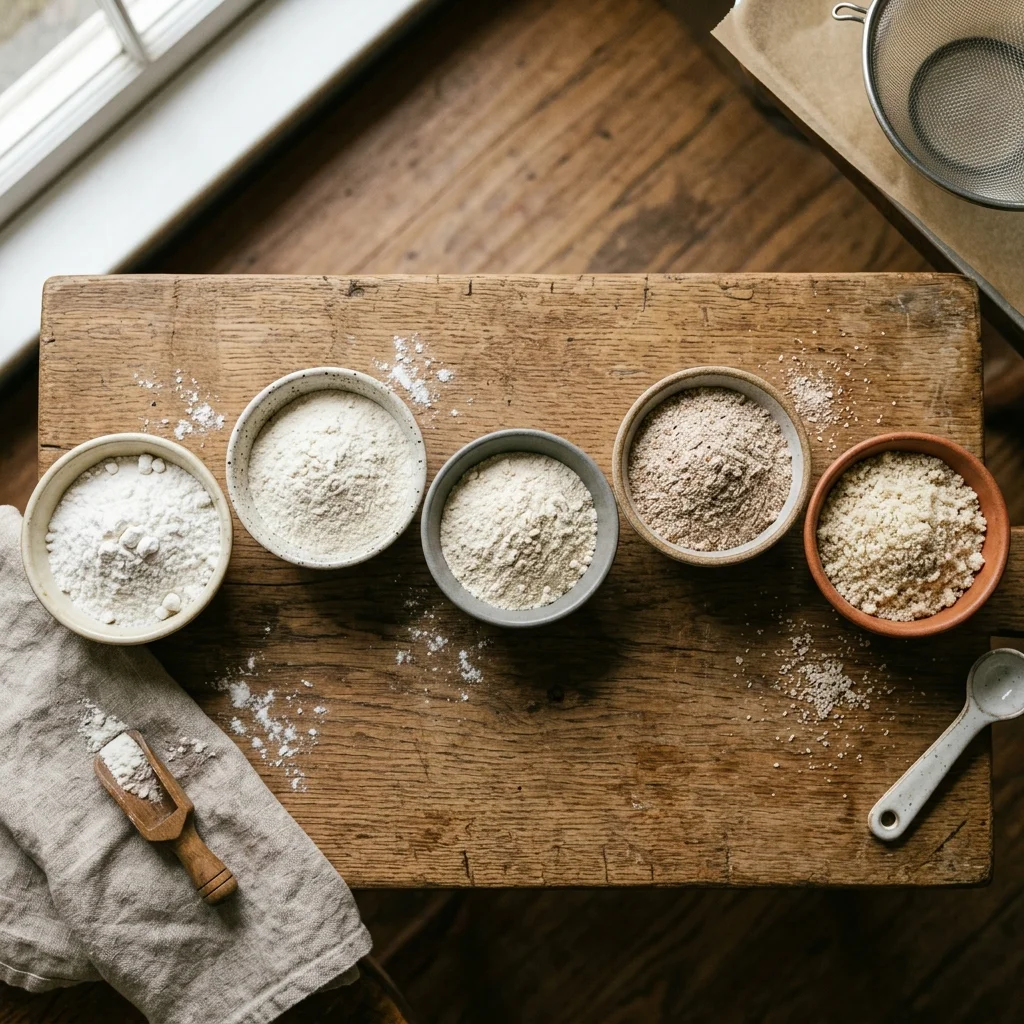
For a complete breakdown of nut flour weights and gluten-free substitutions, visit our dedicated analysis on Almond Flour vs All-Purpose Flour or reference The Master Cups to Grams Baking Conversion Guide.
Does Sifting Flour Change the Measurement?
Sifting aerates flour, breaks up lumps, and introduces air spaces between flour particles. Whether sifting alters your ingredient quantity depends entirely on when you sift in relation to measuring.
Pay close attention to recipe phrasing:
- "1 cup sifted flour": Sift the flour first into a bowl, then spoon and level 1 cup from the sifted pile. Sifted flour is extremely aerated, weighing roughly 110 grams to 115 grams per cup.
- "1 cup flour, sifted": Measure 1 cup of flour first (preferably 125g by weight or via spoon-and-level), and sift it afterwards into your mixing bowl.
Misreading this wording can cause a 10% volume discrepancy in delicate batters like sponge cakes and soufflés.
Can You Measure Flour Without a Scale?
Yes, you can measure flour accurately without a scale by applying the spoon and level method described above. While volume measuring will never match the 100% precision of a digital gram scale, spooning aerated flour into a dry measuring cup gets you within 5% of target recipe weights.
Keep in mind that environmental factors like ambient weather can shift flour weight slightly. Learn how in How Ambient Humidity Affects Flour Weight and Dough Hydration.
Common Flour Measuring Mistakes
Avoid these seven frequent flour measurement errors that cause unexpected baking failures:
- Scooping directly from the bag: Plunging a cup straight into dense flour packs down particles, adding up to 30g extra flour.
- Tapping or shaking the measuring cup: Tapping a cup filled with aerated flour on the counter forces air out and compresses flour downward.
- Using a liquid measuring cup for flour: Clear glass liquid measuring cups with pour spouts cannot be leveled across the top rim.
- Ignoring flour type density: Substituting bread flour or cake flour cup-for-cup without adjusting for weight density differences.
- Using an arbitrary grams-per-cup number: Assuming every ingredient weighs 240g per cup (which applies only to water and liquid milk).
- Confusing "sifted flour" and "flour, sifted": Sifting before versus after measuring shifts final ingredient amounts.
- Scooping flour out of humid storage: Flour stored in non-airtight containers absorbs moisture from high humidity air, increasing density.
For more common baking measurement pitfalls, review our expert summary on Top 7 Gram-to-Cup Conversion Mistakes.
Quick Flour Measurement Cheat Sheet
Bookmark this handy quick-reference cheat sheet for standard all-purpose flour measurements in domestic baking:
| Volume Measurement | Spoon & Level Weight (Grams) | Ounces (oz) | Scooped Weight Range (Avoid) |
|---|---|---|---|
| 1 Cup AP Flour | 125 g (120g KA) | 4.41 oz | 140g – 160g |
| 3/4 Cup AP Flour | 94 g | 3.31 oz | 105g – 120g |
| 2/3 Cup AP Flour | 83 g | 2.93 oz | 93g – 106g |
| 1/2 Cup AP Flour | 62.5 g | 2.20 oz | 70g – 80g |
| 1/3 Cup AP Flour | 41.5 g | 1.46 oz | 47g – 53g |
| 1/4 Cup AP Flour | 31 g | 1.10 oz | 35g – 40g |
| 1 Tablespoon AP Flour | 7.8 g | 0.28 oz | 9g – 10g |
Frequently Asked Questions
1. What is the most accurate way to measure flour?
The most accurate way to measure flour is by weight in grams using a digital kitchen scale. Mass measurement eliminates variations caused by flour packing, fluffing, or ambient humidity.
2. Is it better to scoop or spoon flour?
It is significantly better to spoon flour into your measuring cup. Scooping directly from the bag compresses flour particles, adding up to 30% extra flour by volume and drying out your baked goods.
3. How do you measure flour with a spoon and level?
Fluff the flour first with a fork or whisk, gently spoon aerated flour into your dry measuring cup until mounded, avoid tapping or shaking the cup, and sweep excess flour off the rim with a flat knife back.
4. How many grams are in 1 cup of all-purpose flour?
One US customary cup of all-purpose flour weighs 125 grams according to standard USDA density references, or 120 grams according to King Arthur Baking standards.
5. Should I sift flour before measuring?
Only sift flour before measuring if your recipe explicitly specifies "1 cup sifted flour". If it calls for "1 cup flour, sifted", measure 1 cup first using spoon-and-level or scale, then sift afterwards.
6. What happens if you use too much flour?
Using too much flour shifts the liquid-to-dry ratio, producing dense, dry cakes, hard cookies that fail to spread, stiff bread dough, and heavy muffins.
7. Can I measure flour without a kitchen scale?
Yes. Using the spoon and level method provides a reliable volume measurement that closely approximates target weight within 5% accuracy.
8. Can I use a liquid measuring cup for flour?
No. Liquid measuring cups have extended pour spouts above the line marker, making it impossible to level off excess flour flat with a straight edge.
9. Why does my flour weigh differently every time?
Flour bulk volume weight shifts depending on how tightly packed it is in storage and how much moisture it has absorbed from ambient air humidity.
10. Is weighing flour really better than using cups?
Yes. Weighing flour eliminates volume measurement error, speeds up prep time, minimizes dirty dishes, and guarantees consistent baking results every single time.
When baking with specialty or alternative flours, explore our gluten-free flour blend density guide and reference verified USDA FoodData Central ingredient density standards.
If you live in mountainous regions, flour moisture content and air pressure require further tweaking. Read our complete guide on high altitude baking adjustments for flour, liquid, and oven temps.
Interactive Flour Weight Converter
Convert grams to cups for all-purpose, bread, cake, and almond flours.
Interactive Flour Weight Converter
Convert grams to cups for all-purpose, bread, cake, and almond flours.
Custom package weights override standard database densities for this session without altering official database records.
Need Full Density Reference Tables?
Explore complete g/cup density tables, USDA ratios, and measurement tools.
Related Baking Guides
Almond Flour vs All-Purpose Flour: Conversion Ratios and Weight Differences
Compare almond flour and all-purpose flour by weight, density, texture, and substitution ratio, with practical tips for cakes, cookies, muffins, and bread.
Flour Baking GuidesGluten-Free Flour Blends: Density Ratios and Xanthan Gum Weights
Learn how gluten-free flour blends differ in weight and structure, when xanthan gum is needed, and how to measure gluten-free flour accurately in grams.