Gluten-Free Flour Blends: Density Ratios and Xanthan Gum Weights
"Learn how gluten-free flour blends differ in weight and structure, when xanthan gum is needed, and how to measure gluten-free flour accurately in grams."
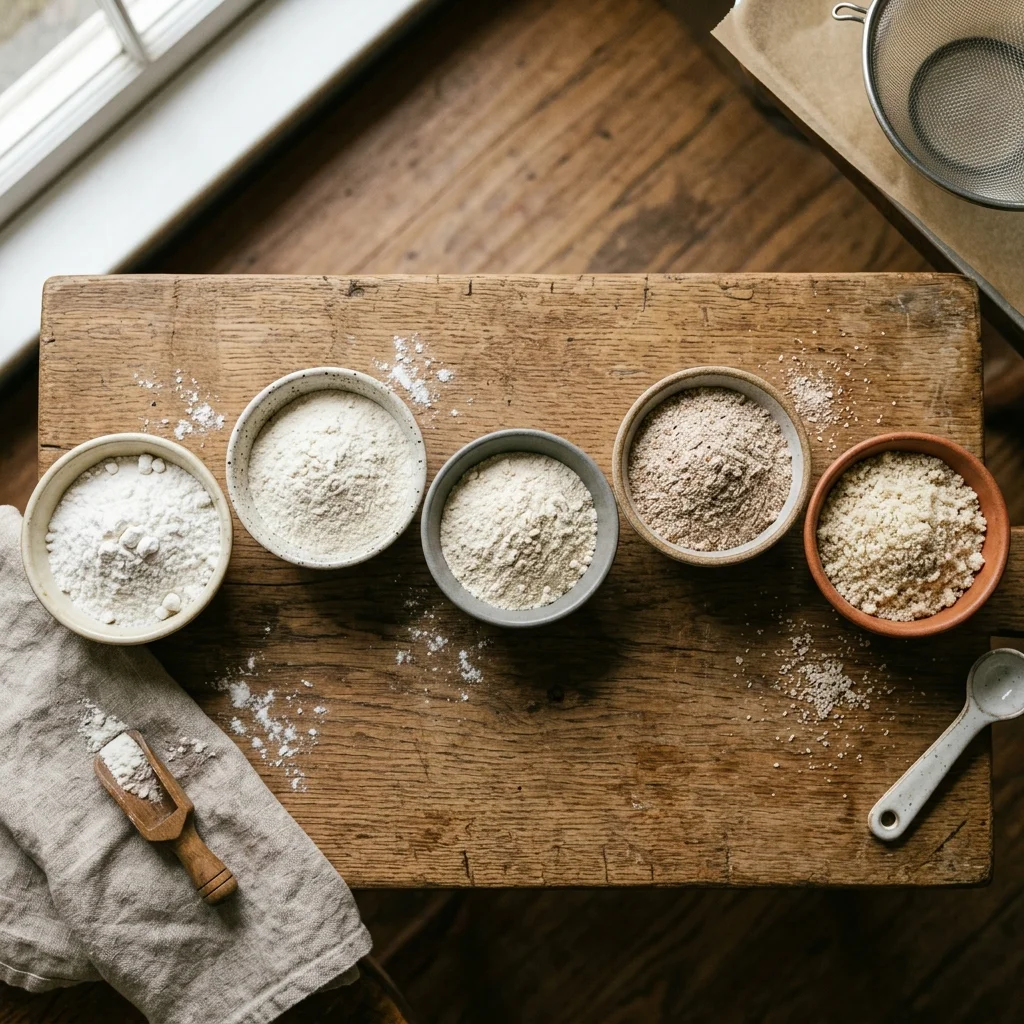
Gluten-free flour is not a single uniform ingredient, and no single weight-per-cup value applies to all gluten-free blends.
Unlike standard wheat all-purpose flour, which has a relatively consistent density (~120g to 125g per US cup when fluffed and leveled), commercial and homemade gluten-free flour blends combine whole grain flours (like brown rice, sorghum, or millet), refined grain flours (like white rice flour), tuber or root starches (tapioca starch, potato starch, cornstarch), nut meals (almond flour), and hydrocolloid binders (xanthan gum, guar gum, or psyllium husk). Because every grain, starch, and binder possesses a distinct bulk density and water absorption rate, one cup of gluten-free flour can weigh anywhere from 120 grams to 148 grams depending on the brand and formulation. Accurate gluten-free baking requires measuring by weight in grams on a digital kitchen scale and tailoring binder ratios to specific baked goods.
Look up alternative starch weights in our Coconut Flour Grams to Cups, explore the complete Flour Conversions Silo Hub, measure micro-binders in the Grams to Teaspoons Calculator, or resize custom blends with our Recipe Scaler.
What Is a Gluten-Free Flour Blend?
To successfully replicate the structural performance of wheat flour without gluten proteins (gliadin and glutenin), gluten-free recipes rely on a compound flour blend composed of three distinct functional categories:
- The Whole/Grain Flour Component (50% to 70% of blend): Provides flavor, protein, fiber, and crumb structure. Common grain flours include white rice flour (mild flavor, crisp texture), brown rice flour (nutty flavor, higher fiber), sorghum flour (soft, cake-like texture), oat flour (moist, tender crumb), millet flour, and buckwheat flour. Nut flours like almond flour add moisture and fat.
- The Starch Component (30% to 50% of blend): Adds lightness, expansion, and gelation during baking. Key starches include tapioca starch (provides chewiness and elasticity), potato starch (retains moisture and builds tenderness), and cornstarch (builds structure and crisp edges).
- The Hydrocolloid Binder Component (0.25% to 1% of total flour weight): Mimics the viscoelastic viscosity of gluten by trapping expanding carbon dioxide gas bubbles released by leaveners. Binders include xanthan gum, guar gum, and powdered psyllium husk.
Why Gluten-Free Flour Weights Differ
Volume-to-weight conversions vary significantly across gluten-free ingredients because each raw flour and starch features a distinct particle size, moisture content, and bulk density:
- White Rice Flour: Dense and heavy (~158g per US cup).
- Tapioca Starch: Very light and powdery (~120g per US cup).
- Potato Starch: Dense, heavy tuber starch (~150g per US cup).
- Sorghum Flour: Medium density (~120g per US cup).
- Superfine Almond Flour: Rich in fat, medium weight (~112g per US cup).
- Wheat All-Purpose Flour (for reference): ~120g to 125g per US cup.
When flours and starches are combined into a commercial blend, the resulting bulk density depends on the exact formulation ratio. A blend containing heavy white rice flour and potato starch will weigh significantly more per cup than a blend formulated primarily with tapioca starch and sorghum flour!
How Many Grams Are in a Cup of Gluten-Free Flour?
Because there is no single universal weight for gluten-free flour, bakers must refer to manufacturer-verified cup weights for specific commercial brands. Never assume every commercial blend weighs 140g per cup!
| Brand / Commercial Blend | Verified Weight per Cup | Contains Xanthan Gum? | Formulation & Best Use |
|---|---|---|---|
| King Arthur Gluten-Free All-Purpose Flour | 120 grams / cup | NO | White rice flour, tapioca starch, potato starch, whole grain brown rice flour. Designed for recipes specifically calling for GF flour where binder is added separately. |
| King Arthur Measure for Measure Flour | 120 grams / cup | YES | Rice flour, whole grain brown rice flour, sorghum, tapioca starch, potato starch, xanthan gum. Formulated for 1:1 substitution in non-yeasted recipes. |
| Bob's Red Mill 1-to-1 Baking Flour | 148 grams / cup | YES | White rice flour, brown rice flour, potato starch, sorghum flour, tapioca flour, xanthan gum. Dense blend; ideal for cookies, brownies, and muffins. |
| Cup4Cup Multipurpose GF Flour | 140 grams / cup | YES | Cornstarch, white rice flour, brown rice flour, milk powder, tapioca flour, potato starch, xanthan gum. High starch content yields crisp pastry and flaky pie crusts. |
| Pillsbury Gluten Free All Purpose Flour | 140 grams / cup | YES | Rice flour, tapioca starch, potato starch, pea fiber, xanthan gum. General 1:1 non-yeasted baking. |
| Pamela's All-Purpose GF Artisan Blend | 120 grams / cup | YES | Brown rice flour, tapioca starch, white rice flour, sweet rice flour, xanthan gum. Soft texture for cakes and quick breads. |
Notice the massive 28g difference between King Arthur Measure for Measure (120g/cup) and Bob's Red Mill 1-to-1 (148g/cup)! If a recipe calls for 2 cups of GF flour and you use volume cups, Bob's Red Mill adds 56g of extra flour compared to King Arthur, turning your cake dense, dry, and gummy. Read more in Top 7 Gram-to-Cup Conversion Mistakes.
Gluten-Free Flour vs All-Purpose Flour
Swapping gluten-free flour blend 1:1 into a traditional wheat flour recipe does not automatically reproduce the structural matrix of wheat flour. Here is why:
- Hydration Speed & Rate: Rice flours and starches absorb liquids much slower than wheat flour. Un-hydrated rice flour feels gritty on the tongue. Resting gluten-free batter for 20 to 30 minutes before baking lets the starches hydrate fully, eliminating grittiness.
- Protein Structure & Tensile Elasticity: Wheat flour contains gluten proteins that form a stretchable elastic web when hydrated and kneaded. Gluten-free flours lack gluten, so dough cannot stretch or trap steam without added binders.
- Cookie Spread & Crumb Tenderization: Starches melt and set at different temperatures than wheat proteins, altering cookie spread, cake rise, and crumb density. Learn flour measuring nuances in How to Measure Flour Correctly.
What Is Xanthan Gum?
Xanthan gum is a hydrocolloid polysaccharide produced through the fermentation of simple sugars by the bacterium Xanthomonas campestris. When hydrated in water or milk, xanthan gum creates a viscous, slippery gel network.
In gluten-free baking, xanthan gum performs key mechanical roles:
- Increases batter viscosity so leavening gas bubbles remain trapped rather than popping.
- Binds starches and water together, preventing crumbly texture and premature staling.
- Provides structural rebound so cakes and muffins do not collapse upon cooling.
Does Gluten-Free Flour Always Need Xanthan Gum?
No. Whether you need to add xanthan gum depends on two factors: whether your commercial flour blend already contains it, and what type of baked good you are making.
- If using a commercial 1:1 or "Measure for Measure" blend: Xanthan gum is already pre-mixed into the flour. Adding extra xanthan gum will ruin your recipe, making it rubbery and slimy!
- If using a custom blend without binder (like King Arthur GF AP): You must add xanthan gum or another binder to your recipe based on the specific baked good category.
- Naturally gluten-free recipes with high egg content: Recipes containing many eggs (such as popovers, crepes, or soufflés) get structural binding from egg proteins and may need no added xanthan gum.
How Much Xanthan Gum Should You Use?
Culinary guidelines published by King Arthur Baking note that approximately 1/4 teaspoon per cup of flour serves as a reliable starting point for many general baking applications. However, required binder amounts vary according to the structural demands of the baked good:
| Baked Good Category | Xanthan Gum per Cup of Flour | Gram Weight per Cup | Structural Rationale & Tips |
|---|---|---|---|
| Cookies & Bars | 1/4 teaspoon per cup | ~0.7 to 1.0 gram | Minimal binder needed; keeps cookies chewy without restricting spread. |
| Cakes & Cupcakes | 1/4 to 1/2 teaspoon per cup | ~1.0 to 1.5 grams | Provides delicate crumb structure without weighing down sponge rise. |
| Muffins & Quick Breads | 1/2 teaspoon per cup | ~1.5 grams | Supports heavier fruit/nut inclusions and builds domes. |
| Yeast Breads & Rolls | 3/4 to 1 teaspoon per cup | ~2.0 to 3.0 grams | High binder strength needed to hold yeast fermentation gas bubbles. |
| Pizza Dough & Flatbreads | 1 teaspoon per cup | ~3.0 grams | Creates rollable, stretchable dough that doesn't crack under a rolling pin. |
Xanthan Gum vs Guar Gum vs Psyllium Husk
Depending on dietary preferences or sensitivity to corn derivatives, bakers can select from three main binder options:
| Hydrocolloid Binder | Origin & Function | Typical Applications | Key Differences & Substitution |
|---|---|---|---|
| Xanthan Gum | Corn-derived bacterial fermentation product. Strong gelation and gas retention. | General baking: cookies, cakes, muffins, bread, pastry. | Standard binder in commercial GF blends. Substitute 1:1 with guar gum in cold applications. |
| Guar Gum | Derived from guar beans. High cold viscosity; excellent for frozen desserts. | Cold batters, ice cream, quick breads, cookies. | Requires ~1.5x quantity of xanthan gum in acidic or high-heat yeasted bread. Preferred for corn-free diets. |
| Psyllium Husk Powder | Ground seed husks of Plantago ovata. Forms elastic gel when hydrated. | Artisan yeast breads, sourdough, pizza crust. | Best binder for open, airy yeast bread structure. Substitute 1 tsp xanthan = 2 tsp whole psyllium husk powder + extra water. |
How to Weigh Gluten-Free Flour
Because gluten-free flours settle, compact, and clump rapidly in storage containers, measuring by volume cup yields inconsistent results:
- The Scooping Trap: Dipping a measuring cup directly into a bag of rice flour packs down the grains, delivering up to 160g per cup, a 30g to 40g excess that ruins batter ratios!
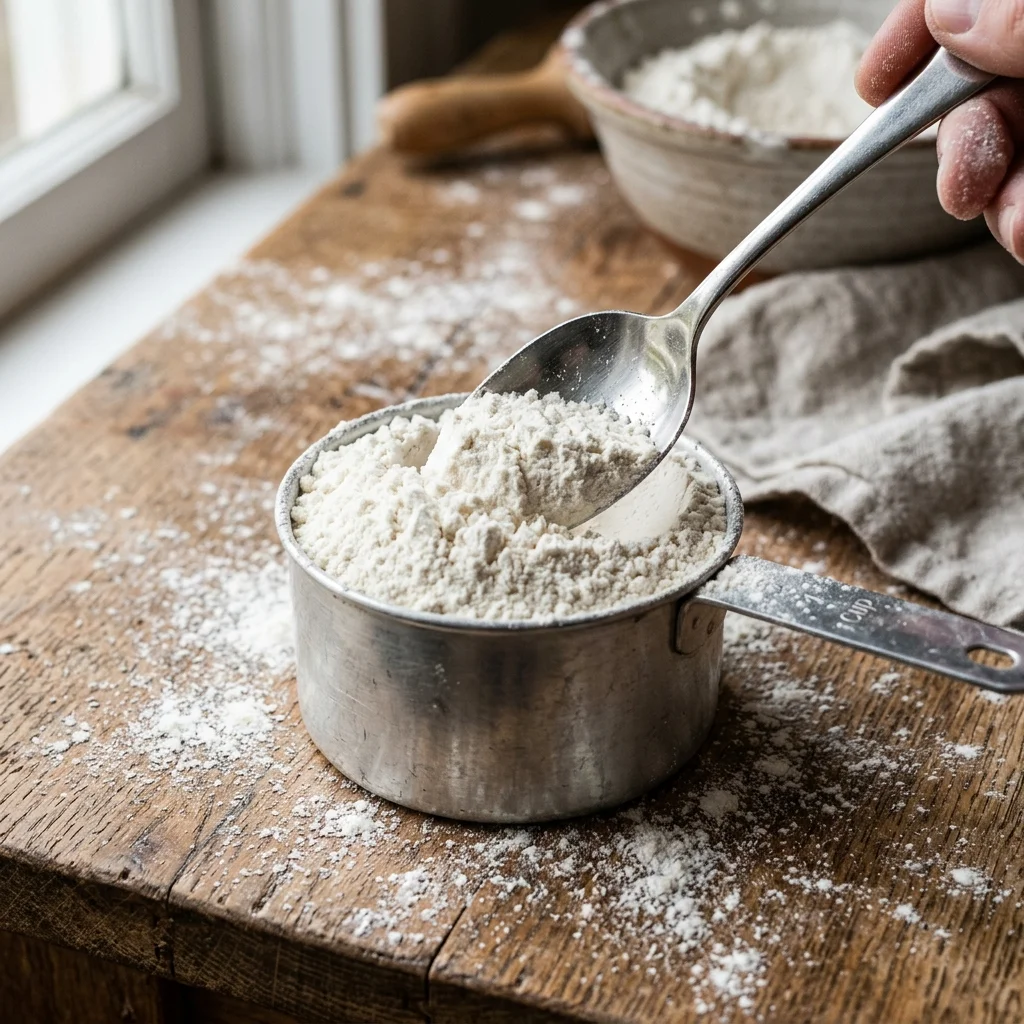
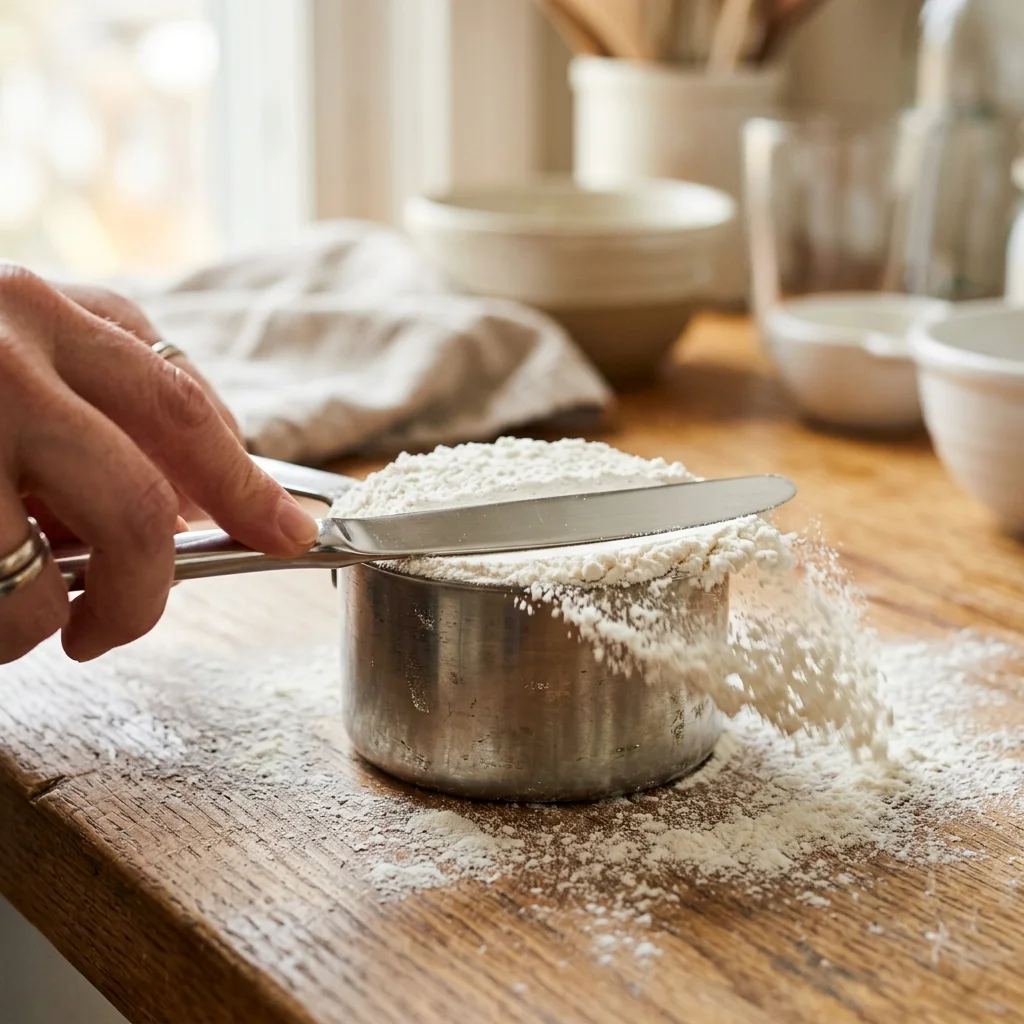
- Fluff, Spoon, and Level Method: Fluff flour with a whisk, spoon lightly into the measuring cup, and sweep flat with a straight knife edge. This yields ~120g to 140g depending on blend composition. Learn step-by-step techniques in Step-by-Step Guide: How to Use a Digital Kitchen Scale for Baking.
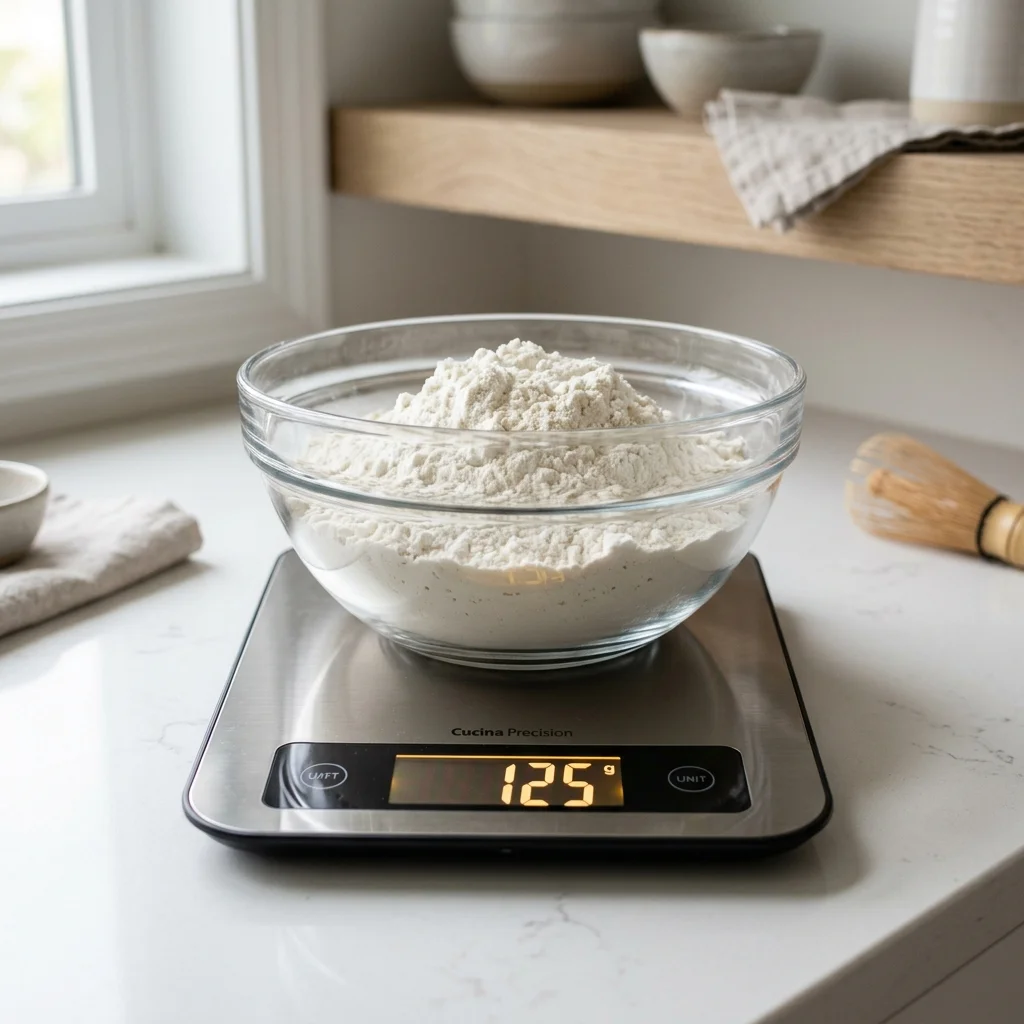
- The Digital Scale Solution: Set a mixing bowl on a digital scale, press tare, and weigh in grams. Weighing guarantees 100% precision every time. Read why weight measurement outperforms volume in Why Baking by Weight Is Superior to Measuring by Volume.
How to Make a Homemade Gluten-Free Flour Blend
If you prefer making a custom gluten-free flour blend, follow a classic 70:30 ratio (70% whole flours to 30% starches) for general baking:
All-Purpose Custom Blend Master Formula (1,000g Total):
- 400g Fine Brown Rice Flour (40% - base structure and protein)
- 300g White Rice Flour or Sorghum Flour (30% - soft texture)
- 200g Tapioca Starch (20% - chewiness and structure)
- 100g Potato Starch (10% - moisture retention and tender crumb)
Whisk thoroughly and store in an airtight container. Note: This blend contains NO xanthan gum! Add xanthan gum separately according to recipe category guidance (1/4 to 1/2 tsp per cup). Check master weight charts in The Master Cups to Grams Baking Conversion Guide.
Gluten-Free Flour for Different Baked Goods
Different baked goods require customized blend characteristics and binder adjustments:
- Cookies: Higher starch content (tapioca/cornstarch) and low xanthan gum (1/4 tsp per cup) encourage proper cookie spread while keeping centers soft.
- Cakes & Cupcakes: Requires lighter flours (sorghum, white rice) and moderate binder (1/4 to 1/2 tsp xanthan per cup) to support delicate air cells without collapsing.
- Pancakes & Waffles: Oat flour or sorghum flour blended with tapioca starch yields fluffy, golden pancakes.
- Muffins & Quick Breads: Brown rice flour, oat flour, and potato starch provide strong moisture retention. Use 1/2 tsp xanthan per cup.
- Yeast Bread & Cinnamon Rolls: High starch content combined with psyllium husk powder (or 3/4 to 1 tsp xanthan gum) holds yeast expansion gases.
- Pizza Dough: Tapioca starch and high-binder formulations allow dough to stretch without tearing under a rolling pin.
Why Gluten-Free Baked Goods Become Gummy
Gummy, wet, or gelatinous textures are among the most common complaints in gluten-free baking. Here are the five main causes:
- Excess Xanthan Gum: Adding extra xanthan gum to a flour blend that already contains binder creates a slimy, rubbery gel.
- Excess Liquid Hydration: Gluten-free batters require liquid, but over-saturating starches prevents internal moisture from evaporating.
- Underbaking: Gluten-free bakes require 5 to 10 minutes longer baking time than wheat recipes to set internal starch gels.
- Starch-Heavy Blend Formula: Blends exceeding 50% tapioca or potato starch become gummy when combined with liquids.
- Slicing Hot Bread: Cutting warm gluten-free bread before it cools completely traps steam inside, turning the crumb gummy! Allow bread to cool completely for 2 hours before slicing.
Why Gluten-Free Baked Goods Become Dry or Crumbly
Conversely, if your gluten-free baked goods crumble into sand upon touch, check these four factors:
- Insufficient Hydration / Un-rested Batter: Rice flours need time and liquid to soften. Rest batter for 20 to 30 minutes before baking.
- Lack of Hydrocolloid Binder: Baking with a blend lacking xanthan gum or guar gum leaves nothing to bind crumbs together.
- Excessive Grain Flour: Blends consisting entirely of whole grain flours without starches lack gelation and fall apart.
- Overbaking: Leaving gluten-free cakes in the oven too long evaporates essential bound moisture. Check pan volume scaling in Baking Pan Conversion Chart.
Can You Replace All-Purpose Flour 1:1?
The answer depends on the product design of your commercial blend. For example, King Arthur Measure for Measure Flour is specifically formulated for 1:1 substitution in non-yeasted recipes (cookies, cakes, brownies, muffins, and pancakes) and contains pre-mixed xanthan gum.
However, King Arthur's Gluten-Free All-Purpose Flour is intended for recipes written specifically for gluten-free flour, contains no xanthan gum, and is not recommended as a direct 1:1 swap into traditional wheat yeasted bread recipes. Always read manufacturer product labels carefully before substituting 1:1!
Gluten-Free Flour Conversion Table
Reference this guide for individual gluten-free flours and starches when building custom blends or adjusting recipes:
| Gluten-Free Ingredient | Approx. Weight per US Cup | Measurement Method | Baking Characteristic & Role |
|---|---|---|---|
| White Rice Flour | 158 grams | Digital Scale (Grams) | Dense, crisp texture; base grain flour. |
| Brown Rice Flour | 130 grams | Digital Scale (Grams) | Nutty flavor, higher fiber; structure building. |
| Tapioca Starch / Flour | 120 grams | Digital Scale (Grams) | Light, powdery starch; adds chewiness and golden browning. |
| Potato Starch | 150 grams | Digital Scale (Grams) | Heavy tuber starch; retains moisture and builds tender crumb. |
| Cornstarch | 128 grams | Digital Scale (Grams) | Structure builder; yields crisp cookie edges and pie crusts. |
| Sorghum Flour | 120 grams | Digital Scale (Grams) | Smooth, cake-like grain flour with sweet, mild flavor. |
| Superfine Almond Flour | 112 grams | Digital Scale (Grams) | High-fat, protein-rich nut meal; adds extreme moisture. |
| Gluten-Free Oat Flour | 92 grams | Digital Scale (Grams) | Ultra-light grain flour; provides soft, fluffy crumb in muffins and pancakes. |
Learn more about leavening adjustments in Baking Powder vs Baking Soda, recipe scaling in How to Double or Halve a Baking Recipe, and sugar impact in Sugar Conversion Guide.
Frequently Asked Questions
1. What is the best gluten-free flour blend?
There is no single best blend for every recipe. Commercial 1:1 blends (like King Arthur Measure for Measure or Bob's Red Mill 1-to-1) work well for cookies and cakes, while custom 70:30 flour-to-starch blends excel in yeast breads.
2. How many grams are in a cup of gluten-free flour?
It varies by brand and blend composition. King Arthur GF blends weigh 120g/cup, Cup4Cup weighs 140g/cup, and Bob's Red Mill 1-to-1 weighs 148g/cup. Always measure on a digital scale in grams.
3. Can gluten-free flour replace all-purpose flour 1:1?
Commercial 1:1 or "Measure for Measure" blends can replace wheat AP flour 1:1 in non-yeasted recipes (cookies, cakes, muffins). They do not perform 1:1 in artisan yeast breads without extra hydration and yeast adjustments.
4. Does gluten-free flour need xanthan gum?
Yes, most gluten-free baking requires a hydrocolloid binder to bind starches and trap leavening gases. However, many commercial 1:1 blends already contain pre-mixed xanthan gum.
5. How much xanthan gum should I use?
A general starting point is 1/4 tsp per cup of flour for cookies, 1/4 to 1/2 tsp per cup for cakes/muffins, and 3/4 to 1 tsp per cup for yeast bread and pizza dough.
6. What happens if I use too much xanthan gum?
Excess xanthan gum makes baked goods gummy, slimy, heavy, and rubbery, preventing batters from rising properly.
7. Can I bake gluten-free bread without xanthan gum?
Yes, you can substitute psyllium husk powder or guar gum for xanthan gum in gluten-free bread recipes.
8. What is the difference between xanthan gum and guar gum?
Xanthan gum is derived from bacterial sugar fermentation (corn-based), while guar gum is derived from guar beans. Guar gum is preferred for cold foods and corn-free diets.
9. Can psyllium replace xanthan gum?
Yes! Psyllium husk powder is especially effective in gluten-free yeast bread and sourdough, creating an open, springy crumb structure.
10. Why is my gluten-free bread gummy?
Gummy bread is usually caused by slicing warm bread too early, using too much xanthan gum, underbaking, or excessive liquid hydration.
11. Why are my gluten-free cookies crumbly?
Crumbly cookies result from a lack of hydrocolloid binder (xanthan gum), un-hydrated rice flour, or insufficient fat and liquid.
12. Should gluten-free flour be measured by weight?
Yes! Measuring gluten-free flour by weight in grams on a digital scale is essential because flour density varies dramatically between brands.
13. Can I make my own gluten-free flour blend?
Yes! A classic homemade blend combines 70% whole grain flours (brown rice, sorghum) with 30% starches (tapioca, potato starch).
14. Why do different gluten-free flour blends weigh different amounts?
Because raw ingredients have different bulk densities: white rice flour weighs 158g/cup, while tapioca starch weighs 120g/cup and oat flour weighs 92g/cup.
For broader flour weighting techniques, see our guides on how to measure flour correctly, almond flour vs all-purpose flour conversions, how to use a digital kitchen scale, and the master cups to grams baking conversion guide.
Interactive Flour Weight Converter
Convert grams to cups for all-purpose, bread, cake, and almond flours.
Interactive Flour Weight Converter
Convert grams to cups for all-purpose, bread, cake, and almond flours.
Custom package weights override standard database densities for this session without altering official database records.
Need Full Density Reference Tables?
Explore complete g/cup density tables, USDA ratios, and measurement tools.
Related Baking Guides
How to Measure Flour Correctly: Spoon and Level Method vs Scooping
Learn how to measure flour correctly using a scale or spoon-and-level method, why scooping adds too much flour, and how accurate measurements improve baking.
Flour Baking GuidesAlmond Flour vs All-Purpose Flour: Conversion Ratios and Weight Differences
Compare almond flour and all-purpose flour by weight, density, texture, and substitution ratio, with practical tips for cakes, cookies, muffins, and bread.